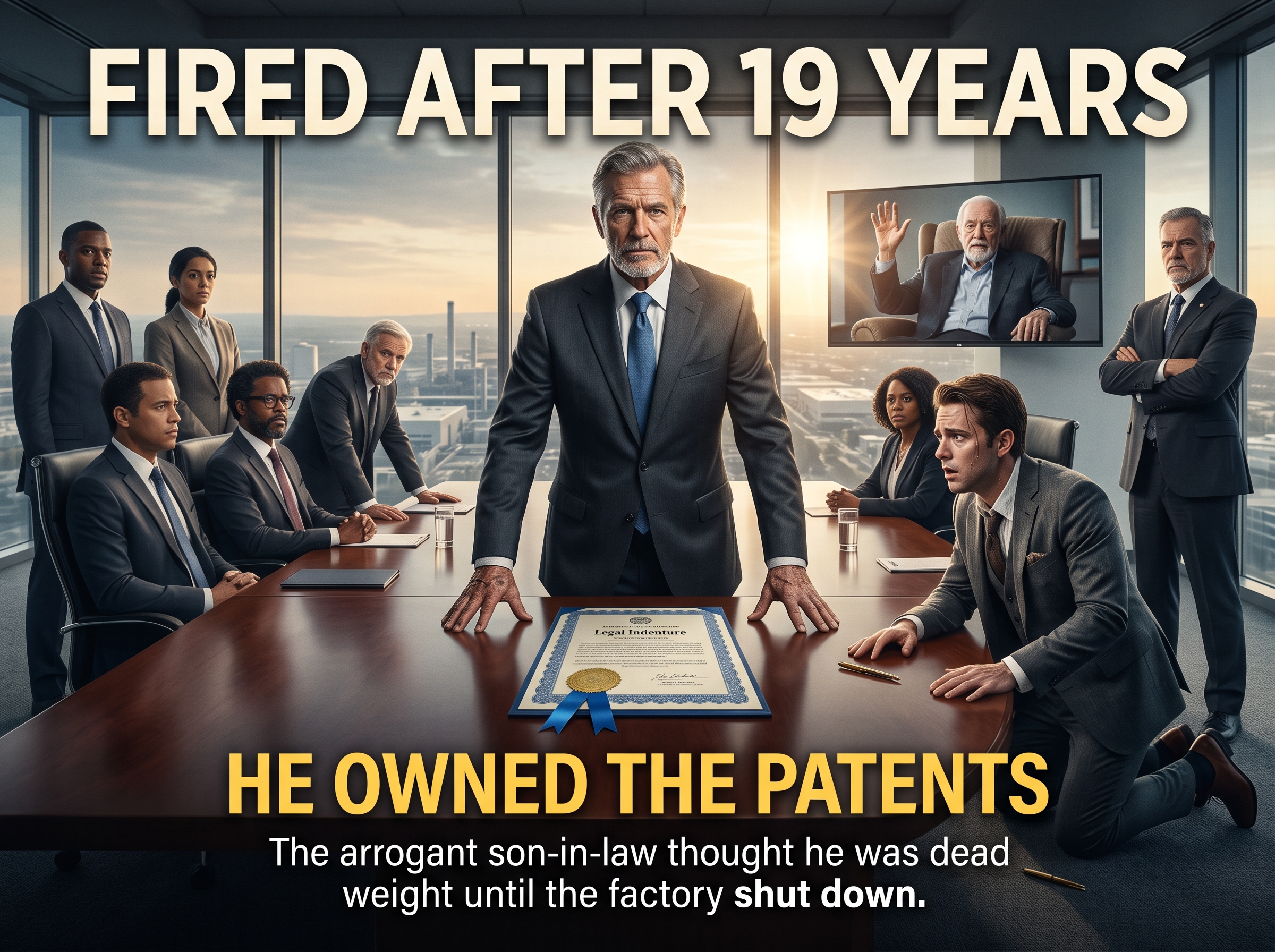
The CEO’s Son-in-Law Fired Me After Nineteen Years A longtime employee is dismissed without warning or gratitude. The new boss believes the matter is finished, but a name from the employee’s past—and problems with suppliers and licensing—begin to unsettle him.
The CEO’s Arrogant Son-in-Law Fired Me After Nineteen Years Without Severance, Unaware That Every Patent, Supplier Covenant, and Exclusive Manufacturing License Was Hand-Signed to My Name Alone
After nineteen years building Apex Precision Machining from a two-lathe machine shop into a global aerospace manufacturer, I was terminated in four minutes by the CEO’s newly appointed son-in-law. He thought I was just an aging line manager—until the multi-million-dollar supply chain ceased to exist overnight.
The cardboard banker’s box on the corner of my metal desk held nineteen years of my life.
Inside was a brass slide rule my father had given me when I completed my master machinist apprenticeship in nineteen-eighty-five; a chipped ceramic mug with Best Line Superintendent stenciled in faded blue glaze, gifted to me by the third-shift tool-and-die crew after our record nineteen-ninety-nine turbine stator run; and a framed photograph of the old machine shop floor when Apex Precision was nothing more than two clattering manual Bridgeport mills squeezed inside a drafty corrugated shed behind the old rail yard.
In that photograph, our founder, Arthur Vance, had his arm thrown over my grease-stained shoulder. We were both thirty-four years younger, our faces smeared with cutting coolant and charcoal dust, grinning like boys who had just pulled gold out of an iron mine.
Arthur had suffered a massive stroke six weeks ago. He was seventy-four now, bedridden in an elite private rehabilitation suite in Greenwich, his speech slurred, his sharp engineering mind trapped behind the fog of damaged synapses.
And in his vacuum sat Derek Sterling.
Derek was thirty-two, wore bespoke Italian suits with no tie, spent four hundred dollars on haircuts that looked like he had just rolled out of an expensive gym, and had married Arthur’s youngest daughter, Chloe, fourteen months ago at a lavish vineyard reception in Napa Valley. Derek had an MBA from an elite business school, an unshakeable contempt for anyone who washed their hands with citrus pumice, and had officially been named Chief Executive Officer by the family-controlled holding board on Monday morning.
It was now Thursday afternoon, two o’clock.
Derek sat behind Arthur’s massive walnut desk, turning a weighted titanium pen over and over between his manicured fingers. He didn’t offer me a seat. He didn’t look at my eyes; his gaze remained fixed on the glowing spreadsheet of his ultra-thin laptop.
“Frank, let’s keep this clean and efficient,” Derek said, his voice carrying that practiced, rhythmic cadence of an executive reciting a corporate reorganization script. “The board has conducted a comprehensive operational efficiency audit across all production verticals. We are pivoting Apex from an analog machine-fabrication model to an automated, third-party logistics platform.”
I stood before the desk, my work boots resting on the thick wool carpet. My uniform was a clean navy button-down with Frank Miller — Master Tooling & Operations Director embroidered over the pocket.
“Pivoting,” I repeated, my voice steady, low, and quiet as a calibrated micrometer.
“Exactly,” Derek continued, tapping a key on his keyboard. “At sixty-one, your skill set is fundamentally legacy-based. You’re an artisan in a market that demands algorithmic scalability. Your current executive compensation package, combined with your accrued defined-benefit pension liabilities, represents an inefficient overhead overhang of four hundred and eighty thousand dollars annually.”
He pushed a single sheet of paper across the dark walnut wood.
“This is your separation notice. Effective immediately. Turn in your facility badge, your master gate key, and your corporate phone to security on your way out through the loading dock. We have waived the standard thirty-day transition period to ensure a frictionless organizational restructuring.”
I looked down at the paper.
There was no severance package. There was no mention of the nineteen years of sixty-hour work weeks, no acknowledgment of the eighty-six turbine components I had personally designed on drafting paper at two in the morning, and no gratitude for the five industrial patents that had kept the company from going under during the crash of two-thousand-eight.
“No severance, Derek?” I asked, my tone neutral.
Derek let out a soft, pitying sigh, shaking his head. “Frank, you’ve been drawing an executive salary for two decades. You’ve been compensated in full for every hour logged. Furthermore, our legal review of your original nineteen-ninety-five employment file shows you never formalized a modern non-compete or severance covenant with Arthur. You were an at-will operational supervisor. The company owes you zero contractual liquidation obligations.”
He picked up his desk telephone, pressing the intercom.
“Marcus, send security to the executive suite to escort Mr. Miller from the premises.”
I looked at Derek Sterling.
I didn’t raise my voice. I didn’t slam my fist on the desk. I didn’t beg for the job that had turned my knuckles knotty with arthritis and cost me my thirty-year-old knees.
I reached out, picked up my cardboard banker’s box, and stepped toward the mahogany door.
“Derek,” I said, pausing with my hand on the polished brass latch.
Derek didn’t look up from his screen. “Yes, Frank?”
“Arthur always told you that a machine is only as good as its tolerances,” I said softly.
“Arthur isn’t running this company anymore, Frank,” Derek sneered, clicking his mouse with cold, dismissive finality. “Welcome to the twenty-first century. Security is waiting.”
I walked out through the double glass doors of the executive wing.
Two young security contractors in black tactical polos escorted me down the freight elevator, through the humming production floor where two hundred machinists stood in stunned, horrified silence, and out onto the wet gravel of the employee parking lot.
The security guard took my plastic proximity fob, dropped it into a plastic evidence bag, and let the heavy iron turnstile gate click shut with a hollow, metallic clang.
I set my cardboard box on the passenger seat of my ten-year-old pickup truck, turned the ignition, and drove out through the industrial gates, watching Derek’s black Porsche idling in the executive spot under the security cameras.
He believed the matter was finished.
He believed he had shaved four hundred and eighty thousand dollars of dead weight from his quarterly balance sheet.
What the boy with the MBA did not know was that in the world of high-precision aerospace manufacturing, you do not buy steel with spreadsheets.
You buy it with blood, honor, and a thirty-year-old signature that no corporate board on earth could ever erase.
Friday morning arrived under a low, bruised October sky that smelled of cold rain and diesel exhaust.
At seven o’clock, Derek Sterling walked through the glass lobby of Apex Precision Machining, holding a ten-dollar iced oat-milk macchiato, his leather laptop folio clutched under his arm.
He was in an exceptional mood.
By terminating Frank Miller on Thursday afternoon, he had demonstrated to his father-in-law’s board that the new administration was decisive, ruthless, and entirely focused on bottom-line margin expansion. He had already scheduled an emergency executive conference call at nine with the procurement team of Lockheed-Martin to finalize the delivery schedule for the Mark-IV hydraulic actuator housings—a sixteen-million-dollar contract that represented forty percent of Apex’s projected annual revenue.
As Derek stepped off the elevator onto the executive mezzanine, his junior vice president of procurement, a nervous twenty-nine-year-old named Kevin, was pacing outside the boardroom doors, his tie loosened, his collar damp with sweat.
“Mr. Sterling,” Kevin stammered, rushing forward. “We have a catastrophic logistical situation in Bay 4.”
Derek frowned, taking a slow, annoyed sip of his coffee. “Kevin, calm down. What is the issue? Did a shift supervisor call in sick?”
“No, sir,” Kevin gasped, holding up a printed manifest. “The raw titanium billet delivery from Allegheny Specialty Metals didn’t arrive at six this morning.”
Derek chuckled, waving his hand with casual contempt. “Then call the dispatch coordinator in Pittsburgh. Tell them their freight driver is late, and if the flatbed isn’t backed into Bay 4 by noon, we assess a five-thousand-dollar liquidated damages penalty per hour under Section Twelve of the master vendor agreement.”
Kevin’s face turned the color of wet chalk.
“I did call them, Mr. Sterling,” Kevin whispered, his voice trembling. “I spoke directly with the regional vice president of distribution at Allegheny. He told me that our delivery wasn’t late. He said our delivery was canceled.”
Derek’s smile froze. “Canceled? On whose authority? We have a five-year rolling procurement contract with an eighty-ton quarterly minimum!”
“The VP said we don’t have a corporate contract, sir,” Kevin replied, handing over the printed memorandum. “He said Allegheny Specialty Metals does not sell aerospace-grade titanium alloy to Apex Precision Machining LLC. He said their exclusive supply covenant is held through a personal master distribution agreement executed in nineteen-ninety-eight with a private certified metallurgist named Franklin J. Miller.”
Derek stopped dead in the hallway. The blood rushed to his temples in a hot, furious wave.
“That’s absurd!” Derek barked, crumbling his paper coffee cup in his fist. “Frank was an employee! Any contract signed by an employee is the sole intellectual and contractual property of the corporation under the standard doctrine of agency! Call their legal department and threaten an immediate breach-of-contract injunction!”
“I tried that, Mr. Sterling,” Kevin said, his voice cracking into panic. “Allegheny’s chief legal counsel called me back ten minutes ago. He laughed at me. He said that in nineteen-ninety-eight, when Arthur Vance couldn’t get credit because of the rail strike, Frank Miller personally pledged his family farm as collateral to Allegheny to secure the proprietary mill runs of the titanium-zirconium alloy. The mill patent for the cooling extrusion process is registered exclusively to Frank Miller’s personal name. Allegheny’s covenant explicitly states that if Frank Miller ceases to oversee operational quality control, the supply allocation terminates immediately by operation of law.”
Derek’s mouth opened, but no sound came out.
“And that’s not all, sir,” Kevin continued, his eyes darting toward the production floor below. “The three five-axis CNC milling centers in Bay 2—the ones cutting the housing chambers for the Lockheed contract—shut down automatically at seven-thirty this morning.”
“Why did they shut down?!” Derek roared, shoving past Kevin toward the mezzanine observation rail.
Below, in the cavernous, two-hundred-thousand-square-foot machining hall, the rhythmic, thunderous hum of the plant was missing.
Instead of seventy machines whining at fifteen thousand revolutions per minute, twenty million dollars of high-tech German machinery sat dark, silent, and dead.
Two hundred union machinists were standing in the central aisle in their blue canvas smocks, drinking coffee, their toolboxes locked, watching the mezzanine with cold, stone-faced amusement.
“The machine operating software threw an emergency authorization fault, Mr. Sterling,” Kevin explained, his chest heaving. “The proprietary G-code kinematic subroutines for the multi-axis toolheads aren’t loaded in the internal machine memories. They were hosted on a secure encrypted server partition.”
Derek slammed both hands onto the stainless-steel mezzanine rail.
“Then unlock the damn server! Call IT and override the administrator credentials!”
“IT spent the entire night trying to crack the partition, sir,” Kevin whimpered, wiping his forehead with a trembling hand. “The cryptographic license key isn’t corporate property. It’s an independent, patented engineering subroutine licensed to Apex on a month-to-month basis for one dollar a year by Miller Precision Algorithms LLC. When Frank’s security credentials were wiped yesterday afternoon at five o’clock… the cryptographic handshake severed automatically. The machines are locked out. We cannot cut a single millimeter of aerospace steel.”
Derek felt a sickening, icy drop in his stomach.
The Lockheed-Martin delivery was scheduled for Monday morning at eight. If the first tranche of thirty actuator housings wasn’t delivered to the defense inspection depot in Connecticut, Apex would trigger a twelve-million-dollar default penalty, lose the supplier certification, and face immediate bankruptcy before his first board review was even thirty days old.
“Where does he live?” Derek whispered, his knuckles whitening as he gripped the rail. “Where does Frank Miller live?!”
The gravel road wound through the rolling, forested hills of northern Connecticut, bordered by drystone walls and towering sugar maples whose scarlet leaves were drifting softly down onto the asphalt in the morning fog.
Ten miles outside the city, nestled in a quiet valley beside a clear, rock-strewn creek, sat my home: forty acres of rolling pasture and an eighteenth-century fieldstone farmhouse my great-grandfather had built with timber hauled from the river bottom.
Behind the stone house stood an immaculate, heated sixty-foot steel outbuilding—my personal workshop.
The shop smelled wonderful: warm mineral oil, cedar shavings, pipe tobacco, and the clean, sharp tang of cutting coolant.
Inside sat two vintage nineteen-forty-two Monarch manual toolroom lathes, restored to factory tolerances within one ten-thousandth of an inch, humming with a quiet, hypnotic rhythm.
I wore my old canvas work trousers, a gray thermal shirt with the sleeves rolled up, and a pair of brass-rimmed safety glasses. I was carefully turning a solid brass marine clock housing on the Monarch, watching the golden metal curl away from the high-speed carbide bit like paper ribbons, sipping black coffee from my chipped ceramic mug.
At ten-fifteen, the crunch of aggressive tires on pea gravel shattered the morning quiet.
Through the workshop window, I saw Derek Sterling’s black Porsche 911 slide to a halt beside my woodpile, throwing gray gravel against the stone foundation.
Derek jumped out of the low sports car.
His Italian leather loafers were instantly coated in damp farm mud; his bespoke suit jacket was unbuttoned, fluttering wildly in the autumn wind; his hair was disheveled, and his neck was flushed a furious, mottled purple.
He didn’t knock. He shoved the workshop door open with both hands, the heavy oak frame banging against the wall.
“Frank!” Derek yelled, his breath wheezing as he stormed down the concrete aisle between my tool racks. “What the hell kind of childish, vindictive sabotage is this?!”
I didn’t flinch. I didn’t shut off the lathe motor.
I leaned over the carriage, checked the dial indicator against the micrometer sleeve, and made a single, microscopic half-turn of the cross-slide handwheel.
Shhhhh-clink.
A hairline ribbon of brass dropped into the chip pan.
“Wipe your boots on the mat, Derek,” I said, my voice low and rhythmic over the hum of the three-phase motor. “You’re tracking mud onto my clean concrete.”
“Shut that damn machine off!” Derek screamed, marching right up to the safety shield, his face twisted in desperate, cornered fury. “Allegheny Metals canceled our titanium run! The CNC bays are completely locked out by an encrypted server subroutine! You sabotaged the Lockheed-Martin contract before you walked out the door!”
I slowly reached up, flicked the heavy cast-iron toggle switch to NEUTRAL, and applied the foot brake.
The spinning lathe chuck slowed, whisper-quiet, and stopped dead.
I took off my safety glasses, laid them neatly on the wooden tool board, picked up my chipped coffee mug, and took a slow, deliberate sip.
“I didn’t sabotage anything, Derek,” I said, looking into his bloodshot eyes. “You fired me yesterday afternoon at two o’clock. You told me my skill set was obsolete. You told me I was dead weight on your quarterly balance sheet. You had two armed security contractors escort me to the gravel like a common thief.”
Derek swallowed hard, his throat clicking, his hands clenching into tight, trembling fists.
“You know damn well what you did!” Derek snarled. “You held back the supply agreements! You kept the proprietary machine licenses in your personal name! That is corporate embezzlement, Frank! That is industrial theft! I have our corporate litigation team preparing emergency federal injunctions right now! We will sue you for thirty million dollars in consequential damages!”
I leaned against the heavy cast-iron bed of the Monarch, crossing my arms over my chest, and let out a soft, dry chuckle that echoed through the high timber rafters.
“Go ahead and file, Derek,” I said softly.
“What?” Derek blanched.
“I said go ahead and file,” I repeated, my gaze boring straight through his expensive facade. “You have an MBA, Derek. But you clearly didn’t bother to read the corporate founding charter before you fired the man who wrote it.”
I pointed toward the small oak roll-top desk in the corner of the workshop.
“In nineteen-ninety-five, when Arthur Vance and I founded Apex Precision, the company had eighteen thousand dollars in debt and zero bank credit,” I explained, each word falling like a lead sinker into the quiet shop. “Arthur was a brilliant design engineer, but he was a terrible businessman. The banks refused to loan him a dime because of his prior bankruptcy in Ohio. So I funded the company.”
Derek blinked, taking a half-step back, his arrogance beginning to crack around the edges. “You… you funded it?”
“I took a second mortgage on this forty-acre farm,” I told him. “I pledged this ground to Allegheny Metals as a personal surety bond. In exchange, Arthur executed an irrevocable master cross-licensing indenture. The building and the commercial marketing brand belonged to Arthur. But the metallurgy supply covenants, the proprietary toolhead kinematic algorithms, and the primary Department of Defense facility clearances were registered to Franklin J. Miller, as an independent technical licensor.”
I pointed to my chipped mug.
“Apex Precision didn’t own those assets, Derek. Apex leased them from me. For one dollar a year. Because Arthur was my brother in everything but blood, and we shook hands on it over a pot of stew on that concrete floor thirty years ago.”
Derek’s face drained of all color, turning the terrifying gray of cold tallow.
“A… a cross-licensing indenture?” Derek whispered, his voice cracking into a high, thin squeak. “Arthur never told me about a cross-licensing indenture.”
“Arthur didn’t tell you because Arthur never planned to replace me with a boy who thinks a machine runs on Excel spreadsheets,” I replied, my voice dropping into an icy, impenetrable register. “When you wiped my security access yesterday at five o’clock, Derek… you terminated the master lease for default. You didn’t just fire your operations director. You evicted your company from its own supply chain.”
Derek Sterling stood frozen in the center of my workshop, the smell of damp wool and hot cutting oil hanging thick between us.
Outside, the autumn rain began to tap a steady, hollow rhythm against the corrugated steel roof.
“Frank,” Derek stammered, his hands coming up in a frantic, placating gesture, his voice shedding every shred of executive polish and descending into sheer, unadulterated panic. “Frank, listen to me… we can fix this. This is just a misunderstanding. A terrible, unfortunate failure of internal corporate communication. You know how high-stakes corporate restructurings are—things move fast, consultants make recommendations—”
“You told me I had no contractual rights, Derek,” I interrupted, my voice level and unmoving as granite. “You told me the company owed me zero liquidation obligations. You told me my twenty years of sweat was an ‘inefficient overhead overhang.'”
“I was wrong!” Derek blurted out, a bead of cold sweat running down his temple, dripping onto his silk collar. “I spoke out of turn! I didn’t have the full historical portfolio in front of me! Look, Frank… we will reinstate your salary immediately. We will double it! Nine hundred thousand a year! Full executive vice-president title! A dedicated driver, a corporate jet allowance—whatever you want! Just log into the server, unlock the CNC kinematic partitions, and call Allegheny Metals to release the titanium flatbed!”
I picked up an oily shop rag from the lathe tray and slowly wiped the brass dust from my fingers.
“I don’t need nine hundred thousand dollars, Derek,” I said quietly. “My farm is paid for. My children have finished college. My wife and I live comfortably on what we have. I don’t care about your titles, and I certainly don’t care about your corporate jet.”
“Frank, please!” Derek screamed, taking two desperate steps toward me, his hands shaking violently as he pulled at his hair. “The Lockheed-Martin delivery is Monday morning at eight! If the actuator housings aren’t on the transport truck, they cancel the sixteen-million-dollar master procurement contract! They invoke the cross-default clause across all three defense subcontracts! The bank calls our thirty-million-dollar operating facility loan on Wednesday! The entire company collapses by Friday!”
“Then I suggest you get your suit dry-cleaned, Derek,” I told him, looking him straight in the eyes. “Because you have a very difficult board meeting to lead next week.”
“You can’t do this to Arthur!” Derek shrieked, his voice breaking into hysterical rage. “Arthur built that company! Arthur gave his life to that factory! If the company goes into bankruptcy, Chloe’s trust fund is wiped out! Arthur’s medical care—his private rehabilitation suite in Greenwich—costs sixty thousand dollars a month! You’re killing your own friend!”
A sudden, terrifying stillness fell over the shop.
The blood in my veins turned to liquid nitrogen.
I set the shop rag down on the steel bed.
I took two slow, deliberate steps forward until I was standing six inches from Derek Sterling’s trembling face. Even at sixty-one, with bad knees and scarred knuckles, I had three inches and forty pounds of dense, working-class iron over him.
“Do not dare use Arthur Vance’s name to cover your cowardice, you parasitic little worm,” I growled, my voice dropping into an octave of pure, vibrating menace that made Derek instinctively flinch and pull his chin into his neck.
“You didn’t care about Arthur’s care when you barred his oldest friend from visiting him in the hospital three weeks ago,” I snarled. “You didn’t care about Chloe’s trust when you took a two-million-dollar executive sign-on bonus from the operating reserves while the tool-and-die mechanics were fighting for dental coverage. You thought Arthur’s stroke was your golden ticket to play CEO with a sixty-million-dollar empire you didn’t spend five minutes building.”
Derek backed away until his shoulders struck the frame of an iron tool cabinet, his eyes wide with primal, animal terror.
“Frank… please…” he whined, tears of panic finally breaking through his lashes. “What do you want? Tell me what you want! I’ll give you whatever you ask for!”
I looked at him—looked at his ruined Italian shoes, his trembling chin, his hollow, paper-thin soul that had never known the weight of honest labor or the sacred burden of protecting another human being.
“What I want, Derek,” I said, my voice returning to that terrible, quiet calm, “is for you to get in your German car, drive back to the city, and call an emergency meeting of the Board of Directors for eight o’clock tomorrow morning.”
Derek blinked through his tears. “A… a board meeting? Saturday morning?”
“Saturday morning,” I repeated. “Every voting trustee. Chloe. Arthur’s personal legal conservator, Judge Harold Vance. And Arthur himself, patched in via private video link from his room in Greenwich.”
“Why?” Derek whispered, trembling. “What are you going to do?”
“I am going to deliver my operational efficiency audit, Derek,” I told him, pointing my finger toward the open workshop door. “Now get off my farm before I loose my dogs on your tires.”
Derek didn’t say another word. He scrambled out through the rain, slipped twice in the mud, hauled himself into the leather interior of his sports car, and reversed down the gravel drive with his engine screaming in terror, speeding away into the gray autumn fog.
Saturday morning arrived with a sharp, biting frost that turned the asphalt of the industrial park into slick black glass.
Inside the top-floor executive boardroom of Apex Precision Machining, the temperature was sub-zero, despite the radiant climate control humming through the vents.
Seated around the massive twenty-foot mahogany conference table were the five principal voting trustees of the Vance Family Heritage Trust: Arthur’s elder sister, Eleanor; his personal estate conservator, retired Appellate Judge Harold Vance; two senior institutional partners from the regional manufacturing bank; and Derek’s wife, Chloe Vance-Sterling, looking pale, exhausted, and deeply shaken in a tailored dark wool dress.
Derek sat at the head of the table in his charcoal three-piece suit.
His face was haggard, gray, shadowed with forty-eight hours of sleepless terror. A half-dozen empty espresso cups sat cluttered on the sideboard behind him, and his hands trembled as he repeatedly refreshed the procurement tracking portal on his laptop screen.
Mounted on the center wall of the boardroom was an eighty-inch ultra-high-definition monitor.
On the screen was a live, high-security video feed from the private rehabilitation center in Greenwich.
Propped up in an orthopedic armchair, wearing a clean flannel shirt, was Arthur Vance.
His right side was partially paralyzed, his silver hair was thin, and his speech remained compromised, but his left hand rested firmly on the armrest, and his piercing gray eyes—sharp, clear, and fully alert—were locked onto the boardroom table with absolute, terrifying focus.
Beside Arthur sat his private physical therapist and his longtime personal physician, Dr. Bradley.
“Derek,” Judge Harold Vance said, his gravelly judicial baritone breaking the heavy silence as he tapped an antique gold pocket watch against the table. “It is eight-fifteen. You called this emergency executive board session on twelve hours’ notice, claiming a catastrophic operational failure. Where is the operations director? Why isn’t Frank Miller at this table?”
Derek cleared his throat, his voice cracking slightly as he pulled at his silk tie.
“Judge Vance, members of the trust… as I outlined in my preliminary electronic memorandum yesterday afternoon, Mr. Miller was separated from the firm on Thursday as part of an urgent efficiency restructuring. Unfortunately… Mr. Miller responded by executing an illegal, coordinated sabotage of our digital infrastructure and vendor relationships—”
“L-l-liar.”
A single, thick, gravelly word echoed through the boardroom speakers from the monitor on the wall.
Every head at the table swiveled toward the screen.
Arthur Vance was leaning forward in his armchair, his jaw trembling with profound effort, his left hand pointing an iron finger directly at Derek Sterling’s face.
“You… f-fired… my… b-brother,” Arthur rasped, the syllables dragged out through sheer, agonizing willpower, yet vibrating with a fury that shook the entire room.
Chloe gasped, pressing her hands to her mouth, tears instantly welling in her eyes. “Dad… please, don’t strain yourself—”
“Quiet, Ch-Chloe!” Arthur barked, his eyes blazing with the same fire that had built thirty factories from the mud.
Before Derek could speak, the heavy mahogany double doors of the boardroom swung open with a smooth, decisive glide.
Standing in the doorway was not a broken, humiliated retiree.
It was me.
I wore my best charcoal suit—the one I had bought for my daughter’s wedding four years ago—pressed and immaculate, paired with a clean white shirt and an old silk tie Arthur had given me for Christmas in nineteen-ninety-nine.
Flanking me on either side were two men in dark suits: Thomas Caldwell, the senior partner of the state’s most prestigious commercial contract litigation firm, and Marcus Higgins, the elected president of Local 412 of the International Association of Machinists.
Under my arm, I carried a heavy, blue-ribboned leather portfolio.
Derek leaped to his feet, his chair screeching violently across the hardwood floor.
“Security!” Derek shrieked, his voice rising into a panicked, frantic pitch. “I ordered security to bar this man from the building! Frank Miller, you are trespassing on private corporate property!”
“Sit down, Derek,” Judge Harold Vance commanded, slamming his palm onto the mahogany table with the force of a judge’s gavel.
The eighty-year-old retired judge stood up, adjusting his wire-rimmed glasses, looking at the young CEO with profound, withering contempt.
“Frank Miller is not trespassing, Derek,” Judge Vance stated in a cold, clinical tone. “Frank Miller is here under my personal executive summons, as the legal conservator of the majority voting equity of this corporation. Counselor Caldwell, take your seat. Frank… come to the table.”
I walked down the length of the room, the click of my dress shoes ringing with absolute authority.
I did not look at Derek.
I stopped at the foot of the table, looked up at the large monitor on the wall, and met Arthur’s fierce, tear-filled gray eyes.
I lifted my right hand in a quiet, solemn salute.
“Morning, Arthur,” I said softly.
On the screen, a slow, radiant smile spread across the paralyzed left side of Arthur Vance’s face.
“M-morning… Frank,” Arthur whispered through the speakers, a tear cutting a clean path down his weathered cheek. “B-balance… the books.”
“Right away, partner,” I replied.
I opened the blue-ribboned portfolio, laid three heavy bound dossiers before Judge Vance and the bank trustees, and turned to face the room.
The boardroom was emptied of all sound save the faint hum of the video monitor and the ragged, shallow breathing of Derek Sterling.
“Members of the Board,” Thomas Caldwell began, his voice ringing with the razor-sharp precision of an elite appellate litigator. “We have assembled this morning to review the catastrophic breach of fiduciary duty executed by Derek Sterling between October twenty-first and October twenty-fourth.”
Derek slammed both hands onto the table, leaning forward, his eyes wild with desperate, cornered venom.
“Fiduciary duty?!” Derek shouted, glaring at Caldwell. “I saved this company four hundred and eighty thousand dollars in uncontracted legacy overhead! Frank Miller had no employment contract! He was an at-will employee!”
“Frank Miller was not an employee, Mr. Sterling,” Caldwell replied, his tone icy and calm as he tapped the first blue-ribboned dossier. “Under the 1995 Master Formation Charter of Apex Precision Machining, Frank Miller is the primary holder of the Sovereign Technical Indenture.”
Caldwell looked at the two bank trustees, who were already rapidly scanning the highlighted clauses of the contract before them.
“For nineteen years,” Caldwell explained, “Apex Precision has operated under a five-party cross-licensing framework. The proprietary metallurgy covenants with Allegheny Specialty Metals, the three international extrusion patents for turbine components, the facility security clearances with the Department of Defense, and the master cryptographic operational licenses for every five-axis milling center in this plant are the private, unencumbered intellectual and personal property of Franklin J. Miller.”
Chloe looked up from her dossier, her eyes wide with total, disbelieving horror, turning on her husband.
“Derek?” Chloe whispered, her voice cracking. “Is this true? You told me Frank was just a shop manager! You told me he was an overpaid line supervisor!”
“He is a line supervisor!” Derek screamed, his face contorting into a mask of frantic, sweating hysteria. “It’s an archaic legal maneuver! It’s an unconscionable monopoly covenant! No court in the country will uphold an agreement that allows an individual to hold a defense contractor hostage!”
“The agreement was reviewed and certified by the United States Department of Defense Procurement Command in nineteen-ninety-nine, Mr. Sterling,” Caldwell stated, sliding a certified military memorandum across the wood. “And furthermore, under Section Nine, Paragraph Four of the 1995 charter, any attempt by an executive officer to terminate, diminish, or impair the operational oversight of Franklin J. Miller without the unanimous, notarized consent of the primary founder constitutes an immediate, catastrophic Material Event of Default.”
The senior bank trustee, an elder financier named David Crawford, took off his reading glasses and looked at Derek with absolute disgust.
“Do you have any idea what you’ve done, Sterling?” Crawford said, his voice trembling with furious professional contempt. “The moment that default executed on Thursday afternoon, our fifteen-million-dollar revolving credit facility froze automatically. Allegheny canceled our eighty-ton titanium allocation. And Lockheed-Martin’s general counsel called my personal cell phone at six this morning.”
Crawford tossed his pen onto the table with a sharp, sickening crack.
“Lockheed has formally issued a forty-eight-hour Notice of Cure,” Crawford continued. “If thirty actuator housings are not certified and ready for transport by five o’clock on Monday afternoon, they terminate the master agreement, assess twelve million in liquidated damages, and revoke our defense supplier security clearance permanently.”
Derek sank into his leather chair, clutching his head in both hands, his chest heaving as if he had been submerged in freezing water.
“No…” Derek wept, his arrogance disintegrating into pathetic, sniveling terror. “No… please… David, listen to me… we can settle… we can pay Frank… Frank, tell them! I offered you nine hundred thousand dollars yesterday! I offered you the executive vice-presidency!”
I looked at Derek Sterling.
The silence stretched over the table for ten long seconds.
“You offered me nine hundred thousand dollars of another man’s money to save your own neck, Derek,” I said softly, each word weighted with the quiet, crushing gravity of an anvil. “You didn’t care about the sixty-two machinists on the third shift whose pensions you were planning to freeze in November. You didn’t care about the apprentices. You didn’t care about the nineteen years Arthur and I spent sleeping on cots in Bay 1 when the roof leaked and the banks wouldn’t cash our checks.”
I turned to Judge Harold Vance and David Crawford.
“Under Article Twelve of the Master Indenture,” I announced, my voice carrying clear and steady through the quiet room, “upon a certified Material Event of Default, the primary technical licensor holds the unilateral authority to invoke an immediate Emergency Board Receivership.”
Judge Vance nodded firmly, pulling a heavy fountain pen from his pocket.
“The petition is verified, Frank,” Judge Vance said. “The trustees are prepared to vote.”
On the wall monitor, Arthur Vance lifted his left hand high into the air, his fingers spread wide, his gray eyes shining with fierce, triumphant light.
“V-vote… Frank!” Arthur commanded through the speakers.
Judge Vance raised his hand. Eleanor Vance raised hers. David Crawford and the secondary bank trustee raised theirs immediately.
Four out of five voting shares.
Chloe Vance-Sterling sat with her head bowed, weeping softly into her hands, her diamond ring resting motionless against the mahogany wood, refusing to cast a dissenting vote.
“The motion carries unanimously,” Judge Harold Vance declared in a booming, formal voice. “Derek Sterling is immediately relieved of all executive, fiduciary, and corporate authority as Chief Executive Officer of Apex Precision Machining. His employment is terminated for cause, without severance, liquidation distribution, or corporate indemnification.”
Derek let out a strangled, breathless cry, sliding off his chair onto his knees on the carpet, clutching the edge of the conference table.
“Chloe!” Derek sobbed, reaching blindly for his wife’s dress. “Chloe, please! Tell your uncle! Tell your father! I did this for our family! I did this to protect our future!”
Chloe pulled the fabric of her skirt cleanly out of his grasp, standing up from the table, looking down at him with eyes that had finally seen through the hollow, parasitic vanity of the man she had brought into her father’s house.
“You didn’t do this for our family, Derek,” Chloe said, her voice shaking with bitter tears. “You did this for yourself. You almost destroyed my father’s life.”
She turned to me, her chin trembling, her face flushed with shame.
“Frank,” Chloe whispered, her eyes pleading for grace. “Can you save the plant? Can you save what my father built?”
I looked at the daughter of my oldest friend.
I reached out, took her trembling hand into mine, and gave it a gentle, reassuring squeeze.
“Your father’s plant isn’t dying today, Chloe,” I told her softly. “Not on my watch.”
I looked at Marcus Higgins, the union president standing at my shoulder.
“Marcus,” I said. “Sound the whistle.”
At precisely eight-forty-five on Saturday morning, the massive steam horn atop the main power plant of Apex Precision Machining roared to life.
It was a sound that hadn’t been heard on a weekend in twelve years—three long, deafening blasts that echoed across the valley, bouncing off the brick warehouses and rolling through the neighborhoods where two hundred union machinists lived.
Within forty minutes, the employee parking lot was flooded with pickup trucks.
Men and women arrived in flannel shirts, work boots, and denim jackets, carrying their heavy steel toolboxes, their lunch coolers, and their thermos jugs.
There were no whispers of layoffs, no panic over corporate restructurings, and no fear of bankruptcy.
They had heard the news: Frank was back.
At nine-fifteen, I stepped onto the elevated wooden inspection platform in the center of Bay 2, wearing my clean navy button-down with the master machinist badge pinned over my heart.
Beside me stood Marcus Higgins and David Crawford from the bank.
Below the platform, two hundred machinists, tool-and-die specialists, quality inspectors, and apprentices crowded the central concrete aisle, their faces upturned, their eyes bright with fierce, unshakeable loyalty.
When I stepped to the microphone, the vast, cavernous hall fell into absolute silence.
“Nineteen years ago,” I began, my voice carrying clear and steady through the overhead speaker horns without an ounce of strain, “Arthur Vance and I laid the first concrete slab for this bay. We promised each other that as long as an honest machinist worked under this roof, no suit from New York would ever treat our labor like a line item on an auction block.”
A low, rumbling cheer began to build in the back of the room.
“Forty-eight hours ago, someone tried to break that promise,” I continued, my voice rising with firm, unyielding authority. “They tried to tell us that twenty years of craftsmanship was obsolete. They tried to tell us that a spreadsheet could cut titanium.”
The room chuckled, veteran toolmakers shaking their heads with dry contempt.
“I am here to tell you that the spreadsheet is gone,” I announced. “Under the emergency authority of the Vance Family Trust, Derek Sterling has been removed from this property permanently.”
The entire machine hall erupted.
Two hundred workers began to applaud, shouting and whistling, their cheers echoing off the corrugated steel ceiling like thunder. Men hugged each other in the aisles, mechanics slapped their wrench handles against the frames of the idle milling centers, and old Walt, the sixty-eight-year-old master toolmaker from Bay 1, let out a rebel yell that rattled the light fixtures.
I raised both hands for quiet.
The cheers died down, replaced by a focused, electric silence.
“We have thirty-six hours, boys,” I said, leaning over the wooden railing. “Lockheed-Martin needs thirty actuator housings on the inspection truck by five o’clock on Monday afternoon. The raw titanium billets are arriving from Allegheny on a special chartered freight flatbed at noon. The cryptographic software partitions are unlocked, the machine tool offsets are calibrated, and the coffee in the breakroom is fresh.”
I looked out over the sea of men and women I had known for half my life.
“Who’s taking the weekend shift with me?”
Every single hand in that room went into the air.
Two hundred men and women roared in unison: “WE ARE!”
“Then let’s make some chips,” I smiled.
The whistle blew a single, sharp blast, and the floor of Apex Precision Machining came roaring back to life with a ferocious, beautiful vengeance.
The giant overhead bridge cranes began to roll on their steel rails, their warning bells clanging rhythmically; the high-pressure coolant pumps surged into life, hissing as the milky white oil flooded the cutting beds; and sixty multi-axis CNC spindles spun up to fifteen thousand revolutions per minute, whining through the air in a magnificent, industrial symphony of raw American manufacturing.
I stepped down from the platform, grabbed my brass-rimmed safety glasses from my pocket, and walked over to Bay 2, taking my place beside the lead apprentice on Machine Number One, right where I belonged.
For thirty-six hours, the plant operated like an iron clockwork engine fueled by adrenaline, black coffee, and unyielding pride.
Nobody went home.
The wives and husbands of the machinists arrived in the afternoon carrying five-gallon pots of homemade chili, trays of warm cornbread, and boxes of fresh doughnuts from the local Polish bakery.
Retired toolmakers who had left the company five years ago showed up in their old work aprons, volunteering to deburr components by hand, sweep the aluminum chips from the runways, and inspect tolerance depths with optical comparators so the primary operators never had to lift their eyes from the spindle glass.
I didn’t sit in the corner office.
I spent twenty-eight consecutive hours on the concrete floor, moving from machine to machine with my father’s brass slide rule and a five-inch digital micrometer in my hand.
I adjusted the feed rates on Machine Four when the toolhead began to chatter against the heavy titanium alloy; I hand-ground a custom carbide boring bar at three in the morning when an imported insert chipped during a precision bore pass; and when the final finishing cut was made on Housing Number Thirty at four o’clock on Monday morning, I personally ran the laser coordinate measuring probe across the seal faces.
The digital readout flashed green across all three axes:
Tolerance Deviation: 0.00008 inches.
Eight hundred-thousandths of an inch. Half the width of a human hair across an eight-hundred-pound block of aerospace titanium.
A cheer broke out around Machine One that spread through the entire bay like a rolling wave.
At precisely seven-thirty on Monday morning, an unmarked blue transport tractor-trailer bearing the Department of Defense logistics seal backed into Bay 4.
Flanking the truck were three senior procurement inspectors from Lockheed-Martin, led by Colonel James Vance (no relation to Arthur, but a veteran defense auditor known across the Pentagon as an immovable wall of regulatory perfection).
Colonel Vance stepped into the bay carrying a military tablet and an ultrasonic eddy-current testing unit, his eyes scanning the gleaming rows of thirty completed Mark-IV actuator housings, each resting in its custom-molded wooden transport cradle, cleaned, oiled, and certified with an aerospace quality stamp.
Beside the cradles stood David Crawford, Judge Harold Vance, and me, wearing our safety glasses.
For two grueling hours, the three military inspectors tested the housings.
They ran ultrasonic sound waves through the titanium walls looking for internal micro-fissures; they tested the thread pitches of forty-eight hydraulic bolt holes on every unit with hardened steel plug gauges; and they verified the material heat-lot certifications directly against Allegheny’s metallurgical laboratory ledgers.
At nine-forty-five, Colonel Vance lowered his tablet, took off his gloves, and turned to face us.
He didn’t look at the bank trustee. He didn’t look at the retired judge.
He looked straight at me, his weathered face breaking into a crisp, respectful smile.
“Mr. Miller,” Colonel Vance said, his voice echoing across the quiet loading dock. “In twenty-five years of evaluating aerospace supplier contracts for the United States Air Force, I have never seen thirty high-stress flight components executed with a zero-defect rate across sixty-two discrete geometric tolerances.”
He extended his right hand, gripping my calloused, grease-stained palm with military firmness.
“The delivery is accepted in full. The Department of Defense Master Procurement Certificate for Apex Precision Machining is renewed for five years, with an immediate option for an additional twenty-four units in the spring.”
The loading dock crew erupted into joyous shouts, high-fiving each other as the forklift operators began gently hoisting the heavy wooden cradles into the climate-controlled bay of the military transport.
David Crawford let out a long, ragged exhale of pure relief, taking off his glasses to wipe his eyes.
“We did it, Frank,” the banker whispered, his hands trembling with emotion. “You saved the company.”
“We didn’t do it, David,” I replied, pointing toward the two hundred machinists watching from the production threshold with their arms crossed and their heads held high. “They did.”
By Wednesday afternoon, the corporate storm had cleared, leaving the future of Apex Precision Machining anchored in solid granite.
The emergency receivership had concluded its preliminary findings.
Derek Sterling’s private office on the executive floor had been cleared of its Italian leather furniture, its espresso machines, and its minimalist abstract art.
In its place, the Board of Trustees had officially restructured the corporate governance model.
Under the new master charter, executed by Judge Harold Vance and certified by the probate court, fifty-one percent of the voting equity of Apex Precision Machining was permanently transferred into the Arthur Vance and Franklin Miller Employee Stock Ownership Trust.
The machinists, the toolmakers, the deburrers, and the shipping clerks were no longer employees at will; they were equity partners, sharing directly in every dollar of dividend profit the company generated.
Chloe Vance-Sterling had filed for an expedited legal separation from Derek on Tuesday morning, having uncovered that her husband had used corporate credit lines to secure personal real estate options in Miami. She had resigned from her social clubs in the city and had enrolled in an executive manufacturing management program at the state university, determined to learn the real business of her father’s firm from the ground up.
At two o’clock on Wednesday, a private medical transport van from Greenwich pulled up to the main administration entrance.
Two attendants carefully wheeled a motorized armchair out through the hydraulic lift and into the glass lobby.
It was Arthur.
His doctors had cleared him for a three-hour day visit—the first time the founder had set foot in his factory since his stroke six weeks ago.
He wore his old gray tweed jacket, his hair brushed neat, his left hand holding a polished walnut cane across his lap.
When the motorized chair rolled onto the production floor of Bay 1, every single machine in the two-hundred-thousand-square-foot plant shut down simultaneously.
Two hundred workers lined both sides of the central concrete runway in absolute, reverent silence.
Arthur’s eyes, bright and glistening with unshed tears, moved slowly over the faces of the men and women who had stood by his name in the storm.
As the chair reached the center of Bay 2, I walked out from behind the inspection desk, wiping my hands on a clean shop rag.
Arthur stopped the chair with a touch of his left hand on the joystick.
For a long moment, the two of us just looked at each other—two old men who had started with an empty shed and forty dollars between us thirty years ago, who had weathered bankruptcies, corporate predators, strokes, and the passing of our youth.
Arthur’s chest heaved.
He reached out his trembling left hand, gripping the lapel of my navy work shirt, his fingers digging into the fabric with surprising, ancient strength.
“F-Frank,” Arthur whispered, his voice thick with profound, eternal gratitude. “You… k-kept… the roof… t-tight.”
“I told you I would, Arthur,” I answered, my own voice cracking as tears blurred my vision. “A machine is only as good as its tolerances.”
A soft, joyful laugh rumbled in the old man’s chest.
He reached into the breast pocket of his tweed jacket, pulled out an envelope made of heavy parchment, and laid it directly into my palm.
On the front, written in Judge Harold Vance’s formal legal script, were the words:
APPOINTMENT OF CHAIRMAN OF THE BOARD AND CHIEF OPERATING EXECUTIVE.
FRANKLIN J. MILLER.
“Arthur,” I shook my head gently, looking down at the paper. “I’m sixty-one years old. I don’t belong behind that mahogany desk upstairs.”
Arthur’s jaw set with that familiar, stubborn iron resolve that had made him famous across the manufacturing world.
He lifted his walnut cane and tapped the concrete floor three times with a sharp, echoing crack.
“N-not… upstairs,” Arthur commanded, a brilliant, crooked grin spreading across his face. “D-desk… goes… h-here. On the floor.”
The two hundred workers around us erupted into thunderous, roaring laughter and cheers that shook the very foundations of the building.
Old Walt stepped forward with two junior apprentices carrying a heavy, four-legged solid oak drafting table from the old pattern shop, setting it down right in the middle of Bay 2, beside Machine Number One.
On top of the desk, they set my brass slide rule, my five-inch digital micrometer, and my chipped ceramic mug filled with steaming hot black coffee.
I looked at the desk. I looked at Arthur. I looked at the two hundred partners standing around me in the bright industrial light.
I took off my jacket, tossed it over the back of the oak chair, rolled my sleeves up to my elbows, and sat down at the table.
“Alright, people,” I called out, my voice ringing clear and steady over the quiet laughter. “The Air Force wants twenty-four more actuator housings by March. Who’s running the roughing pass on Bay 3?”
The whistle blew a single, triumphant blast, and the great machines roared into life once more, cutting clean and true into the bright, unbreakable future.
Six months later, on a radiant, golden afternoon in late April, the annual shareholder meeting of Apex Precision Machining convened not in a high-rise downtown hotel, but right on the green lawn between the factory and the river.
Long wooden tables were laid out under a white festival tent, piled high with barbecue, cider jugs, and fresh spring pies.
Two hundred machinists, their spouses, their children, and thirty retired union elders laughed and celebrated in the warm afternoon breeze that carried the sweet scent of blooming apple blossoms across the water.
Arthur Vance sat at the head of the center table, looking stronger, his speech clearer, his left hand raising a glass of sparkling cider in a continuous toast to the people who had saved his life’s work.
To his right sat Chloe, wearing a simple denim shirt with the sleeves rolled up, having spent the last three months working as a second-shift inventory auditor in Bay 4, earning the quiet, genuine respect of every floor mechanic by learning the difference between a high-speed steel reamer and a carbide end mill with her own bare hands.
And at the center of the gathering, wearing my favorite canvas trousers and a fresh navy shirt, sat me.
My daughter, Sarah, who had just given birth to my first grandson three weeks ago, sat beside me, placing the sleeping baby gently into my arms.
“Look at those hands, Dad,” Sarah whispered, smiling through her tears as the baby’s tiny fingers curled around my thumb—a thumb scarred by thirty years of machine tools and metal chips. “He has your grip.”
“Good,” I smiled softly, looking down at the child’s peaceful face. “He’ll need it to hold the tools.”
A sleek, rented compact sedan pulled slowly up to the public curb outside the main security gate, three hundred yards away.
A man in a cheap, rumpled gray suit stepped out into the dust—Derek Sterling.
Over the last six months, his career in the city had evaporated.
When the news of his near-fatal corporate sabotage and his unauthorized Miami real estate maneuvers hit the financial journals, his business school alumni network had quietly closed its doors. He had lost his partnership options, his sports car had been repossessed by the leasing agency, and he was currently working as a mid-level logistics dispatcher for a commercial freight brokerage in New Jersey, earning forty-two thousand dollars a year answering phones in an unheated cubicle.
He stood by the chain-link fence, clutching his cheap plastic briefcase, watching the party on the lawn.
He saw the two hundred workers laughing together; he saw Chloe smiling as she served potato salad to a retired deburrer; he saw Arthur Vance raising his glass; and he saw the sixty-one-year-old machinist he had called “dead weight” holding his grandson in the center of an empire that was now worth eighty million dollars.
Nobody shouted at him. Nobody ran him off.
Marcus Higgins, the union president, walked over to the security gate, holding a paper plate with two barbecue sandwiches and an apple.
He pushed the plate through the turnstile bars, set it on the concrete curb beside Derek’s scuffed shoes, and gave the fallen executive a slow, quiet look of profound, sorrowful pity.
“Take the sandwich, son,” Marcus said softly. “The union pays for the food today. Even for people who don’t know how to work.”
Derek looked down at the paper plate, his chin trembling violently, a single tear cutting a path through the dust on his cheek.
He didn’t take the food.
He climbed back into his rented compact car, slammed the door, and drove away into the gray exhaust of the highway, vanishing into the cold, indifferent distance of the world he had chosen.
On the lawn beside the river, the bluegrass band began to play a lively reel, their fiddle notes dancing on the afternoon wind.
I looked down at my grandson, looked out at the towering brick walls of the plant where the machines were resting quietly until the Monday whistle, and smiled.
The boy with the MBA had thought he could fire a man who had built a foundation with his bare hands.
He didn’t understand that a company is not a piece of paper filed in a Delaware registry; it is not a balance sheet, a brand logo, or an executive bonus pool.
A true enterprise is a covenant—a sacred, unbreakable bond forged between the men who design the tools, the hands that turn the steel, and the unyielding honor that refuses to let an honest brother walk in the dark.
I took a slow sip of my coffee, leaned back in my wooden chair under the spring sun, and listened to the music play long into the golden afternoon.