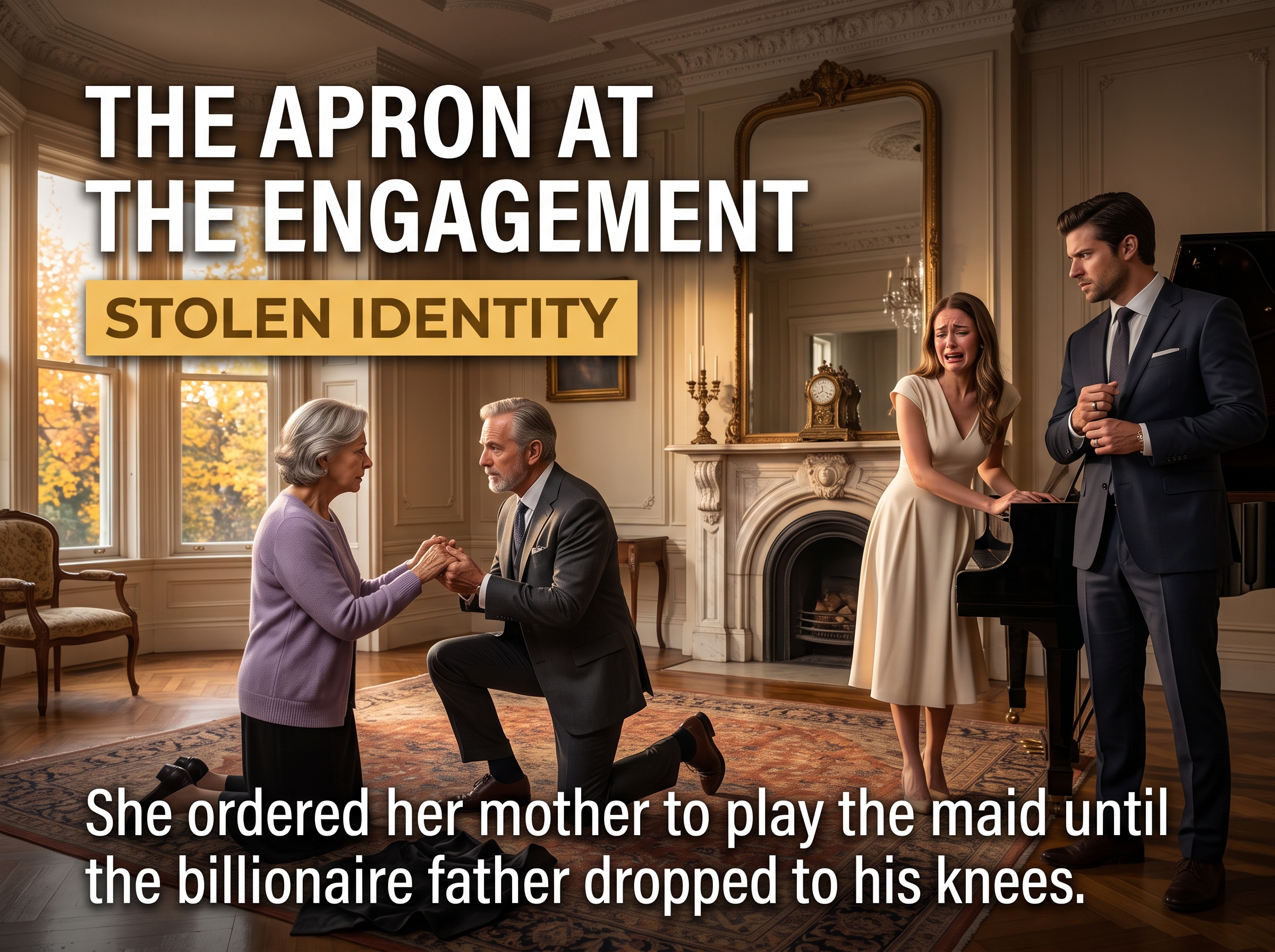
My Daughter Asked Me to Pretend I Was the Housekeeper Before her future in-laws arrived, she handed me an apron and told me not to mention I was her mother. But her fiancé’s father recognized me—and stood up before anyone could introduce us.
My Daughter Handed Me an Apron and Ordered Me to Pretend to Be Her Housekeeper for Her Wealthy Future In-Laws, Until Her Fiancé’s Father Stood Up and Bowed in Shock Before the Entire Room
Minutes before her wealthy prospective in-laws pulled into the driveway, my daughter thrust a black maid’s apron into my hands, whispering that my working-class past would ruin her engagement. But the second her fiancé’s billionaire father walked in, he bypassed everyone and dropped to one knee before me.
The silver tea service on the Italian marble island was arranged with surgical precision. Each porcelain cup sat turned precisely forty-five degrees to the right, the polished spoons gleaming beneath the recessed halogen lights of the four-million-dollar brownstone in Boston’s Back Bay.
I had been on my feet since five that morning. My knuckles, thickened and creased from thirty years of handling dry-cleaning chemicals and pressing industrial steam irons, throbbed with a familiar, dull heat. I adjusted the lace placemats, set out the warm cranberry scones I had baked from scratch, and smoothed the front of my lavender knit sweater. It was my best Sunday sweater, bought five years ago for my daughter’s graduation from Boston University, carefully kept in cedar paper.
My daughter, Chloe, stepped into the kitchen, the sharp clatter of her designer stiletto heels ringing like ice picks against the chevron oak floorboards.
She looked radiant, poised, and impossibly sharp in a tailored cream sheath dress. Her auburn hair—the exact shade her late father’s had been—was pinned into an intricate, elegant twist. Yet beneath the radiant makeup, her jaw was clamped shut, her eyes darting across the room with frantic, calculating tension.
“The catering staff flaked,” Chloe said, her voice breathy and thin, barely louder than the hum of the sub-zero refrigerator.
I smiled, wiping my hands on a kitchen towel. “Don’t you worry about catering, sweetheart. I made the beef Wellington just the way you like it. The consommé is simmering, and the pear tart is in the warming drawer. Your fiancé’s parents are going to feel right at home.”
Chloe didn’t return my smile. She didn’t look at the scones. Her eyes swept down my lavender knit sweater, down to my comfortable orthopedic walking shoes, and a flicker of naked revulsion crossed her face.
She reached into a branded shopping bag sitting on the hall bench and pulled out a stiff, black fabric parcel.
She unrolled it with a sharp flick of her wrist.
It was a heavy black bib apron with white lace trim, accompanied by a small, frilled maid’s cap.
She held it out toward me.
“Put this on, Mom,” Chloe whispered.
I paused, the wooden stirring spoon hovering motionless over the sauce pan. “Chloe? What is that?”
“It’s an apron,” she said, her voice dropping into a desperate, hurried hiss as she glanced toward the front foyer. “The Montgomerys will be here in twenty minutes. Mom, you don’t understand who Julian Montgomery is. He isn’t just an executive; he is the principal shareholder of Montgomery Global Shipping. His wife, Beatrice, sits on the board of the Boston Symphony. They trace their family back to the Mayflower.”
“I know who they are, darling,” I said, a faint prickle of ice creeping down my spine. “Richard told me when you two got engaged. But what does that have to do with an apron?”
Chloe stepped closer, her manicured fingers digging into my forearm, her nails biting into my skin through the soft lavender wool.
“Richard told his parents that I come from an old-money Rhode Island family with trust funds and summer estates,” Chloe confessed, the words spilling out like poison. “He had to! If they knew my mother was Martha Miller—a widowed dry-cleaner who spent thirty years scrubbing grease stains out of strangers’ coats in a strip mall in Lynn—they would never allow the wedding. They would strip Richard of his trust, cut him out of the family firm, and blackball me from every charity board in the city!”
The air left my lungs as if I had been struck in the chest with a flatiron.
“You lied to them?” I asked, my voice barely a whisper. “You told your future husband I was dead?”
“I didn’t say you were dead!” Chloe snapped, her cheeks flushing with defensive venom. “I told them my family lives abroad in Switzerland! But you’re here. You’re standing in the kitchen. If they walk in and see you dressed like… like a suburban grandmother, serving tea, they will ask questions. Julian Montgomery has private investigators on retainer. He will check your name. He will find the shop in Lynn.”
She thrust the black apron into my hands, pressing the coarse cloth against my chest.
“Just for today, Mom,” Chloe pleaded, her eyes wide with cold, unyielding ambition. “Just wear the apron. Pretend you’re Mrs. Gable, our part-time housekeeper. Serve the tea, pour the wine, bring out the Wellington, and stay in the kitchen. If anyone speaks to you, just nod, say ‘Yes, sir,’ and look at the floor. After they leave and the engagement announcement is signed, you can go home. I’ll wire ten thousand dollars to your checking account tomorrow morning. Please. Don’t ruin my life.”
I looked down at the black apron in my trembling, calloused hands.
Thirty years.
Thirty years of standing over six-hundred-degree steam presses twelve hours a day until the skin peeled from my palms. Thirty years of inhaling perchloroethylene fumes so Chloe could have ballet lessons, violin tutors, private preparatory school uniforms, and a debt-free college education.
And now, my price was ten thousand dollars and an apron.
Before I could speak, the deep, resonant chime of the front doorbell echoed through the high ceilings of the brownstone, followed by the deep, booming laughter of a man on the front steps.
Chloe panicked. “They’re here! Tie it on! Tie it on right now, Mom, or I swear to God I will never speak to you again!”
She spun on her heels, straightened her pearls, and rushed toward the front foyer with a bright, fabricated laugh, leaving me alone in the shadow of the marble kitchen, holding the badge of her shame.
The heavy mahogany front doors opened, and a wave of cool autumn air swept into the foyer, accompanied by the polished, aristocratic voices of Boston’s high society.
“Richard, my boy, you’ve chosen a handsome property,” a deep, gravelly baritone resonated through the hallway. “Good masonry. Solid lintels. Very respectable for a young broker.”
“Thank you, Father,” Richard’s eager, deferential voice replied. “Chloe spent months overseeing the interior restoration. She has an impeccable eye for heritage.”
“Only the best for our family, darling,” a woman’s crisp, clipped voice added—Beatrice Montgomery, the matriarch, radiating the cold, effortless superiority of old New England pedigree. “I do hope the service is adequate today. You know how difficult it is to find decent domestic staff in the city these days.”
In the kitchen, my hands moved without my mind’s consent.
I did not tie the frilled maid’s cap into my gray hair. I had too much of my father’s dignity left in me for that. But I slipped the black straps of the apron over my neck and tied the strings behind my back, hiding the lavender sweater.
I looked at my reflection in the dark polished surface of the microwave. My face was pale, lined with the honest fatigue of a woman who had never taken an unearned dollar in her life.
“Just nod, say ‘Yes, sir,’ and look at the floor.”
My daughter’s cruel words burned in my chest like hot grease. I picked up the heavy silver tray, loaded with the fluted crystal champagne glasses and the chilled bottle of Dom Pérignon that Chloe had ordered from an upscale boutique in Beacon Hill.
Taking a deep, trembling breath, I pushed open the swinging service door that separated the pantry from the grand formal parlor.
The parlor was flooded with afternoon sunlight streaming through thirty-foot bay windows.
Seated on an ivory velvet sofa was Beatrice Montgomery, draped in a gray cashmere cape, a diamond brooch pinned to her lapel. Standing by the marble hearth, his back partially turned as he examined an antique bronze clock, was Julian Montgomery—a tall, commanding figure with iron-gray hair, broad shoulders, and an impeccable charcoal Savile Row three-piece suit.
Richard and Chloe stood side by side near the grand piano, their arms entwined, performing the picture of young, aristocratic perfection.
“Ah, excellent, the refreshments,” Chloe said, her voice pitched half an octave higher than normal, her eyes darting toward me with a sharp, warning glare that commanded silence. “Set the tray on the console, please, Mrs. Gable.”
I kept my chin level. I did not look at the floor.
I carried the heavy silver tray across the Persian rug with the steady, balanced grace of a woman who had carried forty-pound hampers of wet linen across slick concrete floors for half her life.
I set the tray down on the mahogany console.
“Julian, darling, do sit down,” Beatrice sighed, waving her gloved hand toward the sofa. “The staff has brought the champagne.”
Julian Montgomery turned away from the mantelpiece, slipping his hands into his trouser pockets, preparing to offer a perfunctory, dismissive nod to the hired help.
His sharp, gray eyes flicked toward the tray.
Then, his gaze lifted.
His eyes locked onto my face.
The air seemed to vanish from the room in a single, violent stroke.
Julian Montgomery stopped dead in his tracks. The relaxed, aristocratic composure that had commanded international shipping boardrooms for forty years evaporated in an instant. His jaw dropped slightly, his eyes widening in total, disbelieving shock, as if he had just seen an angel materialize through the plaster ceiling.
“Julian?” Beatrice asked, frowning with aristocratic irritation. “What is the matter with you? You look as though you’ve seen a ghost.”
Julian didn’t answer his wife. He didn’t look at his son.
Before anyone could utter another syllable, the sixty-two-year-old billionaire stepped forward, completely bypassing Richard, bypassing Chloe, and stopped two feet in front of me, staring into my eyes with an expression of profound, trembling reverence.
“Martha?” he whispered, his voice cracking with emotion. “Martha Miller?”
The formal parlor fell into a silence so absolute you could hear the faint, crystalline tick of the antique bronze clock on the mantelpiece.
Chloe’s hand, resting delicately on Richard’s arm, tightened so hard her knuckles turned the color of chalk. Richard blinked, looking between his father and me in utter bewilderment.
“Father?” Richard chuckled nervously, stepping forward. “You must be mistaken. This is Mrs. Gable. She’s Chloe’s part-time housekeeper—”
“Quiet, Richard,” Julian Montgomery commanded.
He did not shout. He did not turn his head. Yet the sheer, freezing authority in his voice snapped Richard’s jaw shut instantly.
Julian’s eyes never left my face. His gaze swept over my gray hair, the lines around my eyes, and finally settled on the rough black fabric of the maid’s apron tied around my neck.
A dark, dangerous storm gathered behind the billionaire’s gray eyes. His jaw muscles feathered with barely contained fury.
“Mrs. Gable?” Julian asked, his voice dropping into a low, terrifying growl that made Beatrice sit up straight on the sofa.
Slowly, deliberately, Julian reached out with both hands.
He didn’t grab the champagne glass. He didn’t ask for tea.
With fingers that were visibly shaking, Julian Montgomery reached behind my neck, untied the black canvas straps of the apron, and gently lifted the loop over my head. He untied the strings at my waist, crumpled the black garment into a tight, hateful ball in his fist, and hurled it with violent disgust across the room, sending it crashing into the corner baseboard.
“Julian!” Beatrice gasped, pressing a hand to her pearl necklace. “Have you lost your mind?! That is domestic staff!”
Julian turned slowly to face his wife, his son, and my daughter.
“Domestic staff?” Julian repeated, his voice vibrating with an acoustic weight that made the crystal chandelier tremble overhead. “Do you have any idea who this woman is, Beatrice?”
Beatrice scoffed, though her eyes darted nervously toward her husband’s trembling frame. “How could I possibly know her? She’s an elderly woman in an apron—”
“This woman,” Julian stated, each word falling like a granite slab into the room, “is the only reason you are sitting in cashmere today, Beatrice. She is the only reason the Montgomery name exists in this city.”
Richard’s mouth hung open. “Father… what are you talking about?”
Julian turned back to me.
And then, before the horrified eyes of his wife, before his stunned son, and before my pale, trembling daughter, the principal shareholder of Montgomery Global Shipping sank down onto his right knee on the Persian carpet, took my rough, calloused right hand between both of his, and bowed his head until his silver hair brushed my knuckles.
“Martha,” Julian whispered, tears shimmering in his eyes as he looked up into my face. “Thirty-two years. I have spent thirty-two years searching for you across every registry in New England. And I find you standing in an apron in my son’s parlor.”
A sharp, ragged whimper broke from Chloe’s throat. She backed away toward the grand piano, her hand flying to her mouth, her chest heaving as the foundation of her manufactured reality crumbled beneath her feet.
“Julian,” I said softly, my own voice thick with memory. “It has been a very long time.”
“Too long, Martha,” Julian replied, slowly rising to his feet, still holding my hand with gentle, unshakeable strength.
He turned his gaze upon Chloe. The look in his eyes was no longer that of a prospective father-in-law. It was the gaze of an executioner.
“Miss Miller,” Julian said, his voice dropping to an icy, lethal whisper. “Richard told me yesterday that your mother was dead. He told me you came from an old-money trust family in Newport. Would you care to explain why the woman who saved my life from an armed mob in nineteen-ninety-four is wearing a servant’s apron in your kitchen?”
Chloe couldn’t speak. Her lips parted, trembling violently, but the only sound that escaped her throat was a high, thin wheeze. She leaned against the mahogany curve of the grand piano, her knees threatening to buckle beneath her tailored cream dress.
“Dad, please, you’re scaring everyone,” Richard pleaded, stepping between his father and Chloe, his face flushed with panicked confusion. “What armed mob? What happened in ninety-four? You told us your logistics business started with a family bank loan in South Boston!”
Julian let out a bitter, humorless laugh that cut through the room like a whip.
“A family bank loan?” Julian sneered, looking at his son with profound, withering contempt. “Your grandfather was bankrupt in ninety-four, Richard. His shipping lines were in receivership, the unions were striking at the docks, and our family was three weeks away from a federal sheriff’s auction.”
He turned back to the room, his eyes dark with the heavy weight of a history he had buried for three decades.
“In the summer of ninety-four, I was thirty years old,” Julian continued, his voice ringing off the high walls. “I was running our last operating warehouse on the waterfront in Lynn. We were moving three containers of industrial machinery to keep the company solvent. A rival trucking syndicate sent forty armed dock heavies to blockade the gates and burn the manifests. They cornered my driver and me in an alley behind an old brick laundry.”
Beatrice gasped, her gloved fingers clenching her purse. “Julian, you never told me this—”
“Because I was ashamed, Beatrice!” Julian shouted, turning on his wife. “I was ashamed that I was cornered like a rat in an alley, beaten within an inch of my life, while my father sat in his country club drinking gin!”
He pointed his hand toward me.
“It was three in the morning,” Julian said, his voice dropping into an intimate, reverent cadence. “The mob had crowbars and gasoline. They had trapped my driver and me against a padlocked iron gate. And then the rear steel doors of the laundry flew open.”
Julian’s eyes glistened with unshed tears as he looked at my face.
“Out walked Martha Miller,” Julian whispered. “A woman who had just finished a fourteen-hour shift over a boiling starch vat, holding a six-foot iron boiler pipe in both hands. She didn’t call the police; the police were in the syndicate’s pocket. She stood between forty armed men and two bleeding strangers. She swung that iron pipe with the fury of God Almighty. She dragged me through her back door, locked the triple deadbolts, and hid my driver and me in the ventilation tunnels beneath her dry-cleaning plant until dawn.”
Richard stared at me, his eyes wide with disbelieving horror.
“She didn’t stop there,” Julian added, his voice trembling. “My ribs were shattered. My skull was fractured. She tended to my wounds on the floor of her breakroom with hot towels and iodine. And when the sun rose, and I told her that the syndicate was going to seize our last three shipping containers at the railhead because we had no cash for the terminal bond… Martha Miller walked into her back office.”
Julian swallowed hard, his chest heaving with profound emotion.
“She brought out a tin box from under her floorboards,” Julian said softly. “It held twenty-eight thousand dollars in cash—every single penny of her late husband’s life insurance policy, money she had saved to pay off her mortgage and send her five-year-old daughter to school. She handed that tin box to a bleeding man she had met four hours earlier. She looked me in the eye and said, ‘Take your trucks, son. A working man doesn’t let thieves steal his sweat.’“
A suffocating, agonizing gasp tore from Chloe’s throat. She sank onto the piano bench, burying her face in her manicured hands, weeping hysterically.
“I took that money,” Julian said, his voice ringing with absolute certainty. “I paid the terminal bond. I saved the three containers. Those three containers became the foundation of Montgomery Global Logistics. Six months later, when I returned to the laundry in Lynn with a cashier’s check for fifty thousand dollars to repay her, the shop was dark. The landlord told me she had sold the business to pay for specialized medical treatments for her daughter and had vanished into the suburbs.”
Julian turned on his son, his face purple with righteous rage.
“I spent ten years hiring private investigators to find the woman who saved this family from the gutter, Richard!” Julian roared, stepping toward his son until they were inches apart. “And you… you brought her daughter into this house! And her daughter put an apron around her neck and told her to stand in the kitchen like a dog!”
Richard turned slowly to face Chloe, his eyes hollowed out by a sickening mixture of shock, humiliation, and disgust.
“Chloe?” Richard’s voice was barely audible over the sound of her frantic, muffled weeping. “Is this true? You… you told me your parents were Boston Brahmins who died in a sailing accident off Martha’s Vineyard.”
Chloe lifted her head from the piano keys. Her mascara was ruined, running in dark, jagged streaks down her cheeks. Her expensive cream dress was crumpled, her tailored composure completely obliterated.
“Richard, please!” Chloe sobbed, reaching out toward him, her hands trembling uncontrollably. “I had to! You don’t know what it was like growing up in Lynn! The smell of dry-cleaning chemicals on my clothes… the kids at prep school laughing at my secondhand blazers! I wanted to be like you! I wanted to be part of your world! I knew… I knew if your parents knew the truth, they would never accept me!”
“Accept you?!” Julian’s voice boomed like thunder through the brownstone.
The billionaire stepped forward, his eyes blazing with incandescent fury.
“You foolish, arrogant, pathetic girl,” Julian snarled, his voice cutting through her excuses like a broadsword. “If you had walked into my home and told me that you were Martha Miller’s daughter, I would have met you on the front steps with a brass band! I would have deeded half of Montgomery Shipping to your name before the engagement dinner was served! I would have considered my son the luckiest man on earth to marry into the bloodline of the bravest woman I have ever known!”
Chloe shrank back against the piano, as if struck across the face by an invisible hand.
“Instead,” Julian continued, his voice dropping into a register of cold, terrifying finality, “you proved yourself to be a hollow, deceitful parasite. You took thirty years of this woman’s sacrifice—thirty years of her broken knuckles and burnt skin—and you treated her like an embarrassing stain on your social ambitions.”
Julian turned to his wife.
Beatrice Montgomery stood by the velvet sofa, her gold bracelets silent, her face completely pale. For once in her life, the society queen had nothing to say. She looked at me, then looked at the black apron lying crumpled in the corner, her aristocratic pride utterly crushed under the weight of her husband’s testimony.
“Beatrice,” Julian said calmly, though his hands remained clenched in fists. “Go to the car.”
Beatrice didn’t hesitate. She gathered her cashmere cape, avoided looking at anyone, and practically fled down the hallway toward the front door, the click of her heels frantic and hurried.
Julian turned to his son.
“Richard,” Julian said, his tone icy and precise. “Take off your signet ring.”
Richard gasped, clutching his left hand. “Father… please…”
“Take it off,” Julian commanded. “The engagement is canceled. The wedding is canceled. If you spend another night in this brownstone, or if I ever see you associate with this deceitful woman again, you will be stripped of your vice-presidency at the firm and removed from the family trust before the sun sets today. Choose.”
Richard looked at Chloe—looked at her ruined makeup, her desperate, reaching hands, and the web of lies she had spun to ensnare him.
Without a word, Richard pulled the heavy gold Montgomery signet ring from his finger.
He dropped it onto the glass console table, right beside the untouched flutes of Dom Pérignon, turned on his heel, and walked out of the room, leaving the heavy front doors slamming behind him.
Chloe let out a long, piercing wail of despair, sliding off the piano bench onto her knees on the chevron floorboards, clutching her head in both hands.
The brownstone was silent now, save for her ragged, choking sobs.
Julian Montgomery walked over to the console table. He did not look at the champagne. He picked up his gold signet ring, slipped it back into his pocket, and then walked slowly back to where I stood by the marble island.
His face softened instantly. The thunderous titan vanished, replaced entirely by the grateful young man who had hidden in my laundry tunnels thirty-two years ago.
“Martha,” Julian said gently, taking both of my hands in his. “My private driver is waiting outside. I would be deeply honored if you would allow me to escort you home. You have spent enough time in this house.”
I looked down at my daughter weeping on the floor.
My heart ached—not with the bitter anger of revenge, but with the profound, devastating grief that only a mother can feel when she watches her child destroy her own soul.
I had given Chloe everything: my youth, my health, my savings, and my pride. I had protected her from every hardship, shielded her from the cold, and carried her on my shoulders until she was tall enough to look down on me.
I took off my lavender sweater’s silver brooch—the one her father had given me when Chloe was born—and laid it gently on the edge of the marble island.
“Goodbye, Chloe,” I said softly.
I did not wait for her to lift her head. I took Julian Montgomery’s arm, turned my back on the four-million-dollar parlor, and walked out into the clean, cool autumn air of Boston.
The ride inside Julian Montgomery’s black Bentley was whisper-quiet as the luxury vehicle glided across the Tobin Bridge toward the working-class coastal town of Lynn.
Outside the tinted windows, the gray waters of the Atlantic churned beneath an overcast October sky. Inside, the scent of expensive leather and polished walnut surrounded us, but Julian sat quietly, his hands resting on his knees, giving me the space a grieving mother needed.
“I never cashed that cashier’s check, Julian,” I said softly, looking out at the passing industrial shipyards. “When you came back to the laundry thirty years ago, I didn’t hide from you because I was ungrateful. I hid because I knew that if you handed me fifty thousand dollars, Chloe would grow up thinking that money was something that fell from the sky.”
Julian turned to look at me, his gray eyes filled with profound understanding.
“You wanted her to learn the value of work,” he murmured.
“I wanted her to be honest,” I whispered, a single tear finally escaping my lash. “I spent thirty years working seventy hours a week so she would never have to be ashamed of where she came from. But somewhere along the way… I protected her too much. I taught her how to dress for the theater, but I forgot to teach her how to look in the mirror.”
The car pulled up to the curb of my modest, two-family clapboard house on a quiet side street in Lynn. The white paint was peeling slightly around the front porch steps, and my late husband’s hydrangeas were turning brown under the autumn frost, but it was an honest home, paid for with clean money and honest labor.
Julian stepped out first, opening the heavy door for me, offering his arm to help me descend to the pavement.
He looked up at the modest wooden house, took a deep breath of the salt-tinged coastal air, and smiled.
“It smells like the old docks,” Julian said. “Real air. Not that recycled parlor perfume.”
“Would you like a cup of coffee, Julian?” I asked, pulling my keys from my handbag. “I don’t have vintage champagne or crystal flutes, but the kettle is hot, and I have fresh cranberry scones in the tin.”
“Martha,” Julian replied, bowing his head with deep reverence, “there is nothing on earth I would rather have.”
We sat in my small kitchen for three hours.
The room smelled of cinnamon, fresh coffee, and warm pastry. Julian took off his Savile Row jacket, draped it over the back of my vinyl-padded chrome chair, rolled up his French cuffs, and ate three scones with thick butter.
We didn’t talk about society galas or high finance. We talked about my late husband, Arthur, who had been a good, quiet man who died too young. We talked about the old days on the waterfront, the men who had worked the docks, and the years he had spent building Montgomery Global Shipping into an international powerhouse.
“I never forgot the debt, Martha,” Julian said, looking into his coffee mug. “Every time I signed a multi-million-dollar maritime contract, every time we launched a new container vessel in Rotterdam or Singapore, I remembered that tin box under your floorboards. That twenty-eight thousand dollars wasn’t just cash; it was your family’s blood.”
He reached into his breast pocket, pulled out an embossed leather checkbook, and unscrewed the cap of a gold fountain pen.
I reached across the table and placed my calloused hand firmly over his wrist.
“Put it away, Julian,” I told him, my voice steady and unyielding.
Julian looked up, surprised. “Martha, please. I am a billionaire. Let me buy you an estate. Let me buy you a home in Newport, a driver, an endowment—”
“I am sixty-two years old, Julian,” I said with a gentle smile. “My house is paid for. My pension from the dry-cleaning union covers my groceries. I do not need a driver, and I certainly do not need an estate. If you write me a check, you turn that night in nineteen-ninety-four into a commercial transaction. I didn’t save your life for a return on investment; I saved you because it was the right thing to do.”
Julian stared at me for a long moment, his eyes glistening with tears. Slowly, he capped the gold pen and slid the checkbook back into his coat.
“You haven’t changed an inch, Martha Miller,” he whispered.
“Neither have you, Julian,” I replied. “You’re still the stubborn boy who wouldn’t let the mob have his trucks.”
At six o’clock, Julian’s phone buzzed with an urgent text message. He looked at the screen, his expression tightening slightly.
“It’s my head of human resources,” Julian said, standing up and putting on his jacket. “We have an emergency board meeting regarding the international terminal leases tomorrow morning. But before I go… there is something I must do.”
He walked to the front door, turned, and took my hands once more.
“You may not accept my money, Martha,” Julian said with a fierce, solemn smile. “But you cannot stop me from honoring you. The Montgomery name owes you its life, and this city is about to find out why.”
Three days passed in absolute, quiet solitude.
Chloe did not call. She did not come to the house in Lynn. Richard’s phone number was disconnected, and the social media accounts that Chloe had curated with such frantic vanity—full of designer handbags, high-society brunches, and country-club polo matches—vanished from the internet overnight.
On Thursday morning, as I was sweeping the fallen maple leaves from my front walkway, a courier van pulled up to the curb.
A young woman in a crisp navy uniform stepped out, holding a thick, cream-colored vellum envelope sealed with gold wax and stamped with the formal seal of The Boston Harbor Development Authority & The Mayor’s Office.
I wiped my hands on my canvas gardening apron, opened the seal, and read the embossed invitation inside:
The Board of Directors of Montgomery Global Shipping and The City of Boston Request the Honor of Your Presence at the Grand Commissioning of The Boston Marine Cargo Terminal & Logistics Center Saturday, October 28th, at Eleven O’Clock in the Morning Pier 4, South Boston Waterfront.
Attached to the card was a handwritten note in Julian’s bold, angular script:
“Martha — A car will arrive for you at ten. Wear your lavender sweater. It is time for the city to meet the real founder of Montgomery Shipping. — Julian.”
On Saturday morning, at precisely ten o’clock, a sleek black town car arrived outside my gate.
I wore my lavender knit sweater, pressed and immaculate, paired with a dark gray wool skirt and a simple string of faux pearls my late husband had given me for our tenth anniversary.
When the car arrived at Pier 4 on the South Boston waterfront, the scene was magnificent.
Hundreds of people crowded the newly paved terminal plaza beneath towering industrial gantry cranes painted in brilliant maritime blue. The United States Coast Guard band played stirring nautical marches from an elevated pavilion, their brass instruments gleaming in the brilliant October sun.
City council members, state senators, international port directors, and the elite of Boston society were seated in rows of white chairs beneath a vast white canopy fluttering in the harbor breeze.
Television news cameras were mounted on hydraulic arms, broadcasting live to regional stations.
My driver guided me down the center red carpet directly to the front row, seating me in the place of honor right beside the Mayor of Boston and the Governor of the Commonwealth.
At eleven o’clock, the music ceased, and Julian Montgomery stepped to the podium.
He looked magnificent in a dark navy maritime blazer, his silver hair catching the ocean wind, commanding the crowd of eight hundred people with absolute, effortless grace.
“Distinguished guests, civic leaders, and friends,” Julian began, his voice echoing with majestic clarity across the harbor. “Today, we open the most technologically advanced commercial shipping terminal on the Eastern Seaboard—a fifty-million-dollar investment that will create three thousand union jobs for the working families of Massachusetts.”
The crowd erupted into thunderous applause, cheers echoing off the steel hulls of the cargo ships docked along the wharf.
Julian raised his hand for silence. His gaze drifted across the front row, locking directly onto mine with deep, unwavering warmth.
“Many of you believe that Montgomery Global Shipping was built by venture capital and corporate mergers,” Julian continued, his tone turning intimate, solemn, and resonant. “You have read the articles in the financial journals. You have heard the legends of our early days.”
He leaned forward over the podium, his voice dropping into an acoustic gravity that captivated the entire plaza.
“The truth is far simpler, and far more sacred,” Julian said. “Thirty-two years ago, this company was one hour away from total, violent destruction in a dark alley in Lynn. I was cornered, beaten, and ruined. The banks had turned their backs on me. The police were absent. And our city’s elite looked the other way.”
The audience went completely still.
“I was saved by a woman who worked seventy hours a week over an industrial steam press,” Julian announced, his voice ringing with pure, unadulterated pride. “A widow who used an iron boiler pipe to stand between an armed mob and two dying men. A woman who reached under her floorboards and handed her family’s entire life savings to a stranger, simply because she believed that honest work must be protected.”
A collective murmur of awe rippled through the hundreds of guests.
Julian stepped out from behind the podium, walked down the stage stairs, and extended his hand to me.
“Ladies and gentlemen of Boston,” Julian boomed into his lapel microphone, lifting my rough, calloused hand high into the air before the television cameras and the Governor. “Meet the true founder, the moral compass, and the lifeblood of Montgomery Global Shipping: Mrs. Martha Miller of Lynn!”
The eight hundred guests rose to their feet as one.
The applause that followed was like rolling thunder across the harbor. Senators, billionaires, dockworkers, and foreign consuls clapped and cheered, tears streaming down the faces of veteran union longshoremen who remembered the strike of ninety-four.
The Governor bowed his head in deep reverence, and the Mayor stepped forward, presenting me with the ceremonial Gold Key to the Port of Boston.
Julian led me to the edge of the pier, where a massive silk ceremonial ribbon hung across the entrance to the terminal’s main administrative tower.
A large bronze plaque was mounted on the granite wall beside the entrance.
Julian drew back the velvet drape, revealing the words engraved in deep, permanent letters:
THE MARTHA MILLER TERMINAL & SEAFARERS’ ENDOWMENT “A WORKING MAN DOES NOT LET THIEVES STEAL HIS SWEAT.” DEDICATED IN ETERNAL GRATITUDE TO THE BRAVEST WOMAN IN BOSTON.
Tears—clean, pure, and unburdened—flowed down my cheeks as the horn of a massive container vessel sounded three long, triumphant blasts that shook the very granite beneath our feet.
The commissioning gala on the pier lasted until late afternoon, but as the crowd began to disperse and the autumn sun dipped toward the city skyline, painting the harbor in shades of burnt copper and violet, I saw a lone figure standing by the security barrier at the edge of the public parking lot.
She wore a dark, oversized coat with the hood pulled up to conceal her face, clutching a worn leather handbag against her ribs.
It was Chloe.
She had not been invited to the VIP pavilion. She had stood for four hours among the general public behind the chain-link fence, watching the Governor bow to her mother, watching three thousand dockworkers cheer the name of the woman she had ordered to wear a maid’s apron.
I walked away from the catering tents, declining Julian’s offer of an escort, and walked down the asphalt lane toward the fence.
As I approached, Chloe pulled her hood down.
Her face was unrecognizable from the polished, sharp executive who had paced the Back Bay brownstone four days ago. Her eyes were sunken, dark with sleepless exhaustion, her lips cracked, her cheeks hollow. She looked small, frightened, and utterly broken.
“Mom,” Chloe whispered, her voice cracking into a ragged, pathetic rasp through the chain-link wire.
I stopped three feet from her. I did not cross my arms. I did not speak with anger.
“Hello, Chloe,” I said gently.
Chloe buried her face in both of her hands, her shoulders shuddering as violent, retching sobs tore through her chest. She sank onto her knees on the cold asphalt of the parking lot, her fingers clutching the chain-link mesh as if she were a prisoner begging through the bars.
“I lost everything, Mom,” Chloe wept, her words barely coherent through her tears. “Richard moved all his things out on Tuesday… he told the entire brokerage firm what I did. The managing partners asked for my resignation yesterday morning. They said they couldn’t have a senior associate whose character was compromised by public fraud. The landlord in Back Bay canceled the lease because Richard’s name was on the guarantee… I have forty-eight hours to clear my furniture.”
I looked down at my daughter.
This was the girl who had demanded ten thousand dollars of hush money to hide her mother’s existence. This was the girl who had valued Mayflower pedigree over the blood and sweat that had fed her.
“What do you want from me, Chloe?” I asked, my voice carrying the ancient, sorrowful weight of a parent who has watched her child jump into the abyss.
“I don’t know!” Chloe cried, looking up through the wire, her face bathed in bitter tears. “I don’t have anywhere to go, Mom! The girls from my club won’t answer my calls. Courtney and Sarah blocked my number. Everyone knows. The television news has your face on every screen in the city. When people see my last name, they look at me like I’m a monster.”
She reached her trembling, manicured hand through the diamond-shaped opening of the fence, trying desperately to touch the hem of my wool skirt.
“Please, Mom,” she begged, her voice shrinking into the terrified, desperate whimper of a little girl lost in the dark. “Just let me come home. Let me sleep in my old room in Lynn. I don’t need Boston. I don’t need Richard. I just… I can’t be alone anymore.”
I looked at her outstretched hand—the soft, smooth hand that had never scrubbed a floor, never lifted an iron, and never carried a burden.
“You can come home, Chloe,” I said softly.
Chloe’s breath hitched, a glimmer of desperate, pathetic hope flashing in her swollen eyes. “Really, Mom? You’ll let me come home?”
“Yes,” I replied, my voice turning firm, clear, and unshakeable as New England granite. “The bed in your old room is made. But the rules of that house have changed.”
She blinked, confused. “What… what rules?”
“The brownstone furniture stays in storage or goes to the liquidators,” I told her. “The designer clothes will be sold to pay off your credit card balances. And at six o’clock on Monday morning, you will put on a pair of canvas trousers and work boots.”
Chloe gasped, stepping back slightly. “Work boots?”
“Julian Montgomery established an apprenticeship foundation this afternoon in my name,” I said, pointing toward the towering cranes of the new terminal. “Fifty young men and women will begin training on the cargo docks on Monday, learning container logistics, inventory manifest auditing, and freight management from the ground up. They start at the bottom, sweeping the warehouse bays and loading freight palettes with their own bare hands.”
I looked straight into her eyes, my gaze penetrating down to the very bottom of her soul.
“I have secured one position for you, Chloe,” I said. “Not as an executive. Not as a privileged guest. As Apprentice Number Fifty-One. You will earn eighteen dollars an hour. You will take orders from veteran shift supervisors who grew up in the same neighborhood I did. And you will not spend a single dime on perfume, jewelry, or private clubs until you have paid back every dollar of the debt you owe to this city.”
Chloe stared at me, her chest heaving, the sheer, crushing reality of her redemption falling upon her shoulders like a lead blanket.
“And if I refuse, Mom?” she whispered, trembling.
“Then you are a grown woman, Chloe,” I replied with quiet, sorrowful finality. “And the city of Boston is very large, very cold, and entirely indifferent to people who have no honor. The choice is yours.”
I turned my back on the fence, walking toward the terminal pavilion where Julian Montgomery stood waiting by his car.
Behind me, the sound of the chain-link fence rattling sharply echoed through the evening air, followed by the frantic, running footsteps of my daughter scrambling around the security gate, rushing toward my side with her head bowed, ready at last to learn the work of becoming human.
The winter that followed was the harshest New England had seen in twenty years.
By January, the waters of Boston Harbor were choked with jagged slabs of slate-gray ice, and the bitter nor’easters howled across the concrete piers, driving freezing spray against the steel hulls of the cargo freighters.
Every morning at quarter past five, the alarm rang in my little house in Lynn.
I did not wake Chloe. She had her own alarm now—a cheap, plastic digital clock that sat on her childhood nightstand beside her high school textbooks.
At five-thirty, she came down the stairs.
There were no silk blouses, no tailored cream dresses, and no three-hundred-dollar stiletto heels. Chloe wore thick thermal long johns beneath heavy duck-canvas work trousers, a high-visibility orange safety vest with M.M. Terminal Logistics stenciled across the back, steel-toed boots scuffed with diesel grease, and a knit wool watch cap pulled low over her ears.
Her fingernails were cut short, clean but permanently marked by industrial graphite from the cargo manifests. Her face was bare of makeup, scrubbed clean with cold well water, her skin chapped red by the freezing harbor wind.
She packed her own lunch in a metal tin: two peanut butter sandwiches, an apple, and a thermos of black coffee.
She never complained.
When she walked into the terminal breakroom at six-thirty every morning, thirty veteran longshoremen and twenty young apprentices would look up from their newspapers. At first, during the bitter weeks of November, the workers had treated her with cold, mocking silence—the fallen society girl whose mother had forced her to work among the common folk.
They gave her the worst assignments: shoveling frozen slush from the container tracks, auditing freight manifests in unheated steel trailers at three in the morning, and carrying forty-pound tie-down chains through driving sleet.
Chloe took every blow without a word.
When an angry crane operator dropped a crate of machine parts that split open across Bay 4, scattering five thousand steel bolts into the frozen mud, Chloe spent four hours on her hands and knees in sub-zero wind with a magnetic rake until every single bolt was accounted for, her gloves freezing to her fingers.
Marcus Higgins, the veteran shop steward who had worked the docks since the strike of ninety-four, watched her through the frosted window of the terminal office.
At the end of her fourth month, Marcus walked into the breakroom, poured a mug of black coffee from his personal pot, and slid it across the laminate table to where Chloe sat with her bruised, blistered hands wrapped around her thermos.
“Good work on the manifest audit today, Miller,” Marcus said, his gruff voice carrying across the quiet room. “You caught a four-ton weight discrepancy on the Rotterdam freighter that would have snapped a hoist cable. You’ve got an eye for the numbers.”
Chloe looked up, her chapped lips parting in genuine, stunned disbelief.
She didn’t boast. She didn’t drop names.
“Thank you, Mr. Higgins,” Chloe whispered, her voice steady, humble, and full of quiet pride. “I learned it from my mother.”
Marcus nodded once, a slow, approving smile touching the corners of his weathered eyes, and walked out.
From that day forward, Chloe wasn’t the disgraced heiress on probation. She was Apprentice Miller—a woman who held her own on the concrete, who took her shifts in the ice, and who earned the respect of three thousand working men with her own bare sweat.
On Sunday afternoons, our house in Lynn was warm and peaceful.
We didn’t talk about Back Bay. We didn’t talk about high society.
We sat at the small kitchen table, peeling potatoes for pot roast, listening to the classical radio station on the old wooden counter unit. Sometimes, Julian Montgomery would arrive without his driver, parking his black car at the curb, walking up the front steps carrying a box of warm pastries from the North End bakery.
He would sit at our chrome-legged table, drink coffee from a chipped ceramic mug, and review the terminal’s weekly throughput logs with Chloe, testing her on shipping lane logistics and maritime insurance covenants with the rigorous, demanding affection of an uncle who wanted to see his niece excel.
“You’re sharp with the customs classifications, Chloe,” Julian remarked one Sunday in late February, tapping her ledger with his gold pen. “Better than Richard ever was.”
Chloe looked down at her hands—hands that now bore the small calluses and scars of honest labor, identical to mine.
“Richard knew how to spend money, Mr. Montgomery,” Chloe said softly, looking up with clear, untroubled eyes. “He didn’t know what it takes to move the freight.”
Julian looked at me, a profound, triumphant light dancing in his gray eyes, and smiled.
The seed had taken root. The rot was gone. And in the cold, clean soil of discipline and truth, my daughter was finally growing into the woman her father had always dreamed she would be.
Spring returned to the South Boston waterfront with a magnificent, golden thaw.
By late May, the harbor waters sparkled like emeralds under an azure sky, and the warm offshore breezes carried the sweet scent of blooming lilacs from the islands across the bustling shipping lanes.
On a brilliant Saturday morning, the Martha Miller Terminal held its first annual commencement ceremony for the graduates of the Maritime Seafarers’ Apprenticeship Program.
A large wooden stage had been erected on the main apron of Pier 4, shaded by maritime flags of blue and white, overlooking the sparkling basin where four massive container freighters lay berthed beneath the blue gantry cranes.
Hundreds of families—dockworkers, crane operators, logistics clerks, and shipping managers—sat in folding chairs on the clean asphalt, cheering and waving as the fifty-one graduates marched onto the stage in crisp white dress shirts and navy trousers.
I sat in the front row of honor, wearing my lavender knit sweater, the ceremonial Gold Key to the Port of Boston pinned to my lapel.
Beside me sat Julian Montgomery, smiling broadly as he reviewed the commencement program.
Marcus Higgins stepped to the podium, tapping the microphone to quiet the thunderous crowd.
“Ladies and gentlemen,” Marcus announced, his booming voice echoing across the harbor. “Nine months ago, fifty-one young men and women walked into this terminal with soft hands and grand ideas. Today, after one thousand hours of industrial labor, six hundred hours of technical logistics training, and the most brutal winter this port has seen in two decades, they stand before you as certified Master Freight Specialists.”
The crowd erupted into wild cheers, horns from the tugboats in the basin sounding in a joyful, rhythmic chorus.
“Each year,” Marcus continued, his eyes scanning the row of graduates, “the supervisory board awards the Arthur Miller Memorial Medal for Operational Excellence to the apprentice who demonstrated the highest degree of technical competence, personal discipline, and unyielding character under pressure.”
Marcus looked down at his clipboard, a wide, proud grin spreading across his leathery face.
“The board’s decision was unanimous,” Marcus stated. “The Arthur Miller Medal is awarded to Apprentice Chloe Miller.”
My breath caught in my throat. My hands flew to my chest as the tears rushed to my eyes.
The three thousand dockworkers in the audience leaped to their feet, their applause rolling across the concrete like a tidal wave. Men who had spent forty years on the water whistled and cheered, shouting her name: “Miller! Way to go, Miller!”
Chloe stepped forward to the center of the stage.
She stood tall and straight, her shoulders square, her auburn hair pulled back in a neat, professional braid. Her face was tanned by the sun and wind, her eyes shining with a radiant, unshakeable peace that no designer dress could ever provide.
She took the heavy bronze medal from Marcus Higgins’s hands, but she did not hang it around her neck.
She walked down the wooden stairs of the stage, the crowd parting before her in respectful silence, and walked straight down the center aisle toward where I sat.
She stopped before my chair.
Before the Mayor, before Julian Montgomery, before television cameras and three thousand working men, my daughter sank down onto both knees on the concrete pier.
She took my rough, scarred hands into hers—hands that had scrubbed strangers’ stains for thirty years—and laid the heavy bronze medal directly into my open palms.
“This doesn’t belong to me, Mom,” Chloe wept softly, her tears falling warm and clean onto my knuckles. “It belongs to the woman who stood in that alley with an iron pipe. It belongs to the woman who refused to let me stay in the dark.”
I reached down, lifted my daughter’s face between my trembling hands, and kissed her forehead.
“You earned it, Chloe,” I whispered into her hair, my own tears spilling over. “Every single ounce of it. Your father is looking down at this harbor today, and his heart is completely full.”
Chloe buried her face in my lap, wrapping her arms around my knees, weeping with the pure, unburdened joy of a child who has finally earned her mother’s name.
Julian Montgomery stood beside us, his hand resting gently on my shoulder, looking out across the vast, shining expanse of the harbor that had been built on courage, sacrifice, and truth.
The past was forgiven. The apron was burned. And as the great ships moved slowly out to sea, their horns echoing into the endless blue horizon, I knew that our story was finally anchored in the deep, unbreakable waters of grace.