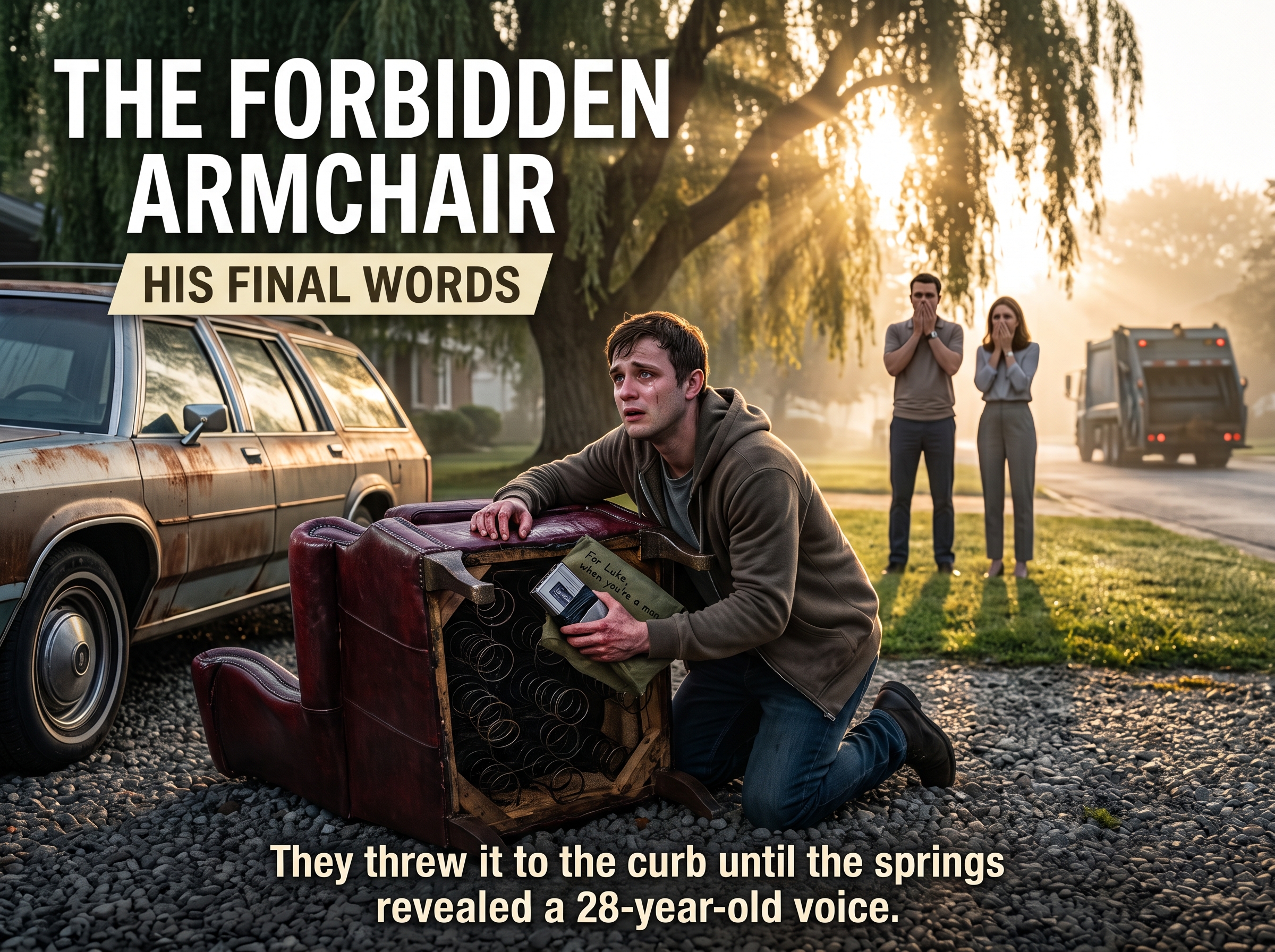
My Mother Threw Away the Old Armchair Nobody Was Allowed to Sit In for Fourteen Years, Calling It Broken Junk—Until I Remembered the Hidden Secret My Disappeared Father Began Whispering Before He Left
For fourteen years, nobody was permitted to touch my vanished father’s worn oxblood chair. When my mother finally called the junk haulers to drag it away, terror struck my chest—because I suddenly remembered the forbidden secret hidden beneath its rotted frame before he walked into the dark.
The winter rain beat against the tall, drafty sash windows of our family home in a relentless, punishing rhythm. For as long as my memories possessed form and weight, the oxblood leather armchair had occupied the dim, recessed alcove of the formal parlor like a piece of unexploded ordinance left behind by a forgotten war. It was a monstrous, heavy thing—Victorian revival, tufted within an inch of its life, with deep-set brass tacks lining its rolled arms and four carved mahogany claw-and-ball feet that bit permanently into the grooved pine floorboards.
To any casual visitor stepping across our threshold, it appeared merely as an eccentric piece of heavy antique furniture, perhaps inherited from a wealthy, tasteless great-uncle. But to the three of us who actually lived inside the house—my mother, my sister Clara, and me—the chair was not furniture. It was a consecrated sepulcher. It was a museum exhibit preserved beneath an invisible dome of absolute terror.
The mandate had been carved into the stone of our domestic life on a freezing Tuesday morning in the middle of November, fourteen years ago. It was the very morning after my father, Arthur Vance, had vanished from the face of the earth without leaving behind a single note, an explanation, or a destination.
I was eight years old when it happened. Clara was only six. That morning, my mother had come downstairs with gray skin and eyes that looked hollowed out by fire. She did not weep in front of us. She did not collapse. Instead, she stood in the center of the parlor, her slender frame shaking violently beneath her faded cardigan, pointed a trembling, white-tipped finger at the oxblood chair, and laid down the iron law of our childhood: Nobody sits in Arthur’s chair. Nobody touches it. Nobody moves it.
My mother never explained the rule. Not once across a decade and a half. Her silence surrounding my father’s disappearance was not the gentle quiet of quiet mourning; it was an active, defensive wall built of barbed wire and stone. When out-of-town cousins came over for Thanksgiving and made the innocent mistake of leaning an elbow against the leather backrest, my mother would freeze mid-stride in the hallway. Her face would turn the color of wet lime, her knuckles whitening around whatever dish or utensil she was carrying.
“Off,” she would whisper, her voice dropping into a register so razor-thin and dangerous that it silenced the room instantly. “Get your hands off it right now.”
So we grew up walking wide circles around it. Over the years, the seasons bleached the crown of the high headrest from a deep, regal wine to the color of a bruised, sun-faded peach. Dust settled into the deep creases of the diamond tufting like gray snow that nobody was ever allowed to wipe away. Clara and I learned to play our games in the far corners of the house, our voices automatically lowering whenever a stray rubber ball rolled beneath those carved wooden talons. The armchair ceased to be a simple reminder of my father; it became a petrified idol of his absence, radiating a cold, impenetrable sorrow that poisoned the air around it.
Eventually, the years did what they always do. Clara grew up, packed her bags for college in Chicago, and never looked back. I finished my degree, found a quiet position working as an assistant archivist at the municipal records library forty miles away, and took a small brick apartment where the silence belonged only to me. We left our mother alone in that sprawling, drafty house, trapped between the walls of her own enduring grief and the shadow of the empty throne.
Then came the telephone call on an ordinary Thursday afternoon.
I was sitting at my metal desk in the archives basement, cataloging microfiche files under the buzzing white glare of fluorescent tubes, when my personal phone vibrated across the veneer. The screen lit up with my mother’s name.
“Jack?” she asked when I picked up. Her voice was unnatural—high, fluttering, and carrying that brittle, forced cheerfulness she always adopted whenever she was doing something catastrophic to avoid feeling pain. “I’m having the downstairs cleared out today. I’ve finally hired the junk haulers. It’s time to downsize this mausoleum before my knees give out entirely.”
A cold drop of water seemed to roll down the inside of my spine. “What do you mean, cleared out, Mom?”
“The parlor,” she said, her breath catching slightly as she spoke over the sound of heavy boots scraping across floorboards in the background. “The sideboards, the broken credenza, and that dreadful, suffocating oxblood chair. The haulers carried it out five minutes ago. The springs were shot completely, Jack. When the men lifted it, the rotten burlap underneath practically disintegrated right onto the carpet. An absolute hazard. I can’t imagine why we kept such trash for fourteen years.”
The blood rushed out of my head with such sudden velocity that the fluorescent lights above my desk blurred into streaks of blinding white. The room titled violently on its axis.
The burlap underneath.
In that single, terrifying fraction of a second, the heavy iron lock that grief and childhood terror had clamped over my mind broke apart, and the memory I had spent fourteen years suppressing came screaming back into the light.
Memory is a treacherous, fragile thing. When a child experiences a trauma too massive for their understanding, the brain does not simply file it away; it buries it beneath floorboards, covers it with silence, and warns the soul never to dig it up.
For fourteen years, I had believed that my father had simply evaporated into the icy November mist. But hearing my mother speak the words—the rotten burlap underneath—tore the veil from my mind with the violence of a physical blow.
It had not been a dream.
It was three o’clock in the morning on the night before he vanished. The house had been frozen in that dead, heavy stillness that only comes in the deepest hours of winter. I had woken up in my small second-floor bedroom, thirsty and shivering, drawn out from beneath my quilts by a faint, rhythmic sound drifting up from below: the rasping scuff of coarse twine, and the distinct, unmistakable scent of cherry pipe tobacco and cold wool.
I had padded barefoot down the carpeted stairs, my eight-year-old hands sliding along the banister, making no sound. When I reached the parlor doorway, the only light came from the orange ember of the streetlamp outside shining through the lace curtains.
My father was not sitting in his chair. He was down on his knees on the hardwood floor, his coat collar turned up against the draft, his face bathed in cold shadow. A sharp utility knife was clenched between his teeth. In his left hand, illuminated by a pale pencil flashlight resting on the carpet, was a heavy, silver microcassette recorder—the kind he used for his field recordings when he interviewed local elders for the state historical society.
I had gasped, the floorboard creaking beneath my bare toes.
My father had not flinched. He had not yelled or scolded. He had slowly taken the knife from between his lips, laid it gently upon the floor, and looked up at me. His eyes were bloodshot, rimmed with a terrible, dark exhaustion that looked like bruises, but his expression was entirely calm—a terrifying, resolute kind of peace.
He had held a single, rough finger up to his chapped lips. Shh.
I had crept forward, trembling, watching as he carefully sliced open a neat slit in the heavy black dust cloth stretched across the underside of the armchair, right between the tension springs. He slipped the silver recorder, along with an extra spool sealed inside a thick, waterproof specimen bag, deep into the coiled gut of the horsehair padding. With methodical precision, he pressed strips of thick black industrial gaffer tape over the opening, smoothing them down until the cut was completely invisible from the outside.
Then, he had reached out, wrapped his large, calloused hand around the back of my neck, and pulled my forehead gently against his own. His skin had smelled of cold metal, motor oil, and tobacco.
“A secret between you and the wood, Jack,” he had whispered, his voice vibrating deep inside his chest. “Promise me you will never speak of this to your mother. Promise me you will let it rest right here, undisturbed, until the day this chair has to move. Only then.”
“I promise, Daddy,” I had whispered back, my voice shaking.
“Good boy,” he murmured, kissing the crown of my head. “Now go back to bed. Forget you saw me tonight. Just remember the wood.”
I had gone back upstairs. And by morning, he was gone. His car keys, his wallet containing every dollar he owned, and his heavy winter overcoat were found neatly aligned on the entryway bench. The front door had been left unlatched, swinging slightly in the sub-zero wind.
When my mother had gathered Clara and me in the parlor that morning and laid down her hysterical, unbreakable ban against touching the chair, my child’s mind had conflated the two commands. My father had told me never to speak until the chair moved; my mother had commanded that the chair must never be touched. To protect my father’s memory—and perhaps to protect myself from the unthinkable reality that he was never coming back—I had locked the memory away in the dark. The taboo had protected the secret, and the secret had sustained the taboo.
Until today. The chair had finally moved. And it was heading straight for an industrial incinerator.
“Jack? Are you still on the line?” my mother’s voice crackled through the phone receiver, sharp with impatience. “I asked if you wanted me to save that old brass reading lamp from his study, or if I should let the men take that as well.”
“Mom,” I said, my voice cracking so loudly that the archivist at the next desk glanced up in surprise. “Where did they take the chair? Who did you call?”
“What? Good heavens, Jack, why on earth do you care? It was just a broken piece of Victorian reproduction. The springs were sticking through the bottom.”
“Mother, answer me!” I shouted, standing up so abruptly that my rolling chair slammed against the metal filing cabinet behind me. “Who were the haulers? Where did they take it?”
“I… I used that city clearance service from the local circular,” she stammered, clearly taken aback by the sudden fury in my voice. “The Tri-County Waste Depot off the marsh highway. They take bulk furniture on Thursdays. Jack, you hated that chair. You wouldn’t even look at it whenever you visited—”
I didn’t wait to hear the rest. I terminated the call, grabbed my wool coat from the back of the chair, and sprinted down the long, fluorescent hallway toward the basement exit, my heart slamming against my ribs like a trapped bird.
The rain turned to sleet by the time I reached the interstate, lashing the windshield of my pickup truck in rattling sheets of ice. The windshield wipers swept back and forth with a desperate, rhythmic squeal, barely keeping up with the gray torrent. I gripped the steering wheel so tightly that my fingers grew numb, the knuckles turning waxy and bloodless.
Fourteen years. For fourteen years, the physical vibration of my father’s voice had been sitting six inches off our living room floor, suspended inside rotten burlap and rusting iron coils.
My father had possessed a voice like dark honey poured over gravel—deep, measured, and soothing. When I was small, before the silence took him, he used to sit beside my bed and read old maritime legends, his voice carrying a resonant, comforting authority that made the shadows in the room retreat. But as the years drifted past, his face had faded in my mind into a series of still photographs, and the sound of his voice had evaporated completely. I could recall the shape of his nose, the square cut of his jaw, the gray hairs sprouting along his temples; but whenever I tried to summon the actual sound of him speaking my name, my mind produced only empty static.
The Tri-County Waste Depot sat on an expanse of low, tide-washed marshland five miles outside the city limits. It was a sprawling, apocalyptic landscape—a gray crater of compacted earth ringed by chain-link fences choked with caught plastic bags and windblown trash. Towering mounds of pulverized sheetrock, soaked mattresses, twisted rebar, and splintered cabinetry rose toward a bruised, slate-colored sky like the ruins of a bombed civilization. The air smelled of diesel exhaust, rotten food, sulfur, and sodden cardboard.
I swerved the truck through the chain-link gates, sending twin plumes of muddy water splashing across the warning signs, and skidded to a halt outside the corrugated tin dispatch shack.
A man wearing an oil-stained fluorescent orange vest and a faded knit cap stepped out onto the porch, chewing on the stub of an unlit cigar. He held up a gloved hand, scowling through the sleet.
“We’re closed to the public for private drop-offs until two, buddy,” he yelled over the continuous rumble of heavy machinery working deeper in the yard. “You gotta turn that rig around and queue up on the access road.”
I leaped out of the truck cab, my leather shoes sinking immediately into three inches of greasy gray slurry. “I’m not dropping anything off! I need to find a piece of furniture that was brought in this morning by the municipal bulk route.”
The man looked at me as if I had spoken in ancient Greek. He took the cigar from his mouth and spat into the mud. “Mister, do you have any idea how many tons of garbage come through that gate every sixty minutes? This isn’t a flea market. Once it hits the scales, it belongs to the county.”
“It was an oxblood leather armchair,” I said, stepping closer, my voice shaking with an intensity that made the man take half a step backward toward his shack. “High back, rolled arms, mahogany feet. My mother sent it away by mistake. It has irreplaceable family property hidden inside the frame.”
The worker let out a dry, wheezing laugh that ended in a cough. “Kid, if it came in on the nine o’clock municipal sweep, it’s already been dumped in Bay Four. And Bay Four is feeding the primary shredder pit right now.”
My breath caught in my throat. “Show me where it is.”
“I can’t let you back there,” he said, shaking his head firmly. “Insurance regulations. There’s excavators, track-loaders, hydraulic jaws swinging around. If a crane drops half a ton of scrap iron on your head, the state sues my union. Get back in your truck.”
I reached into my back pocket, pulled out my wallet, and withdrew every single bill I had—two hundred and forty dollars in crisp cash that I had withdrawn that morning for my rent. I thrust the bills directly into his heavy leather glove.
“Ten minutes,” I pleaded, the freezing sleet plastering my hair to my forehead. “Just give me ten minutes to look before the machine takes it. Please. It’s the only thing I have left of my father.”
The worker stared down at the cash in his palm. His jaw worked silently for a moment, the skepticism in his weathered eyes slowly softening into something resembling reluctant pity. He tucked the money deep into his vest pocket, turned around, and reached into the shack for a battered yellow hardhat.
“Five minutes,” he growled, slamming the plastic hat onto my head. “My name’s Carl. You stay behind my boots, you don’t touch anything metal, and if I blow this whistle, you run like hell for the gate. Follow me.”
He led me past the towering scales and down a slick gravel ramp into the roaring belly of the facility. The noise was deafening—the mechanical roar of diesel engines, the grinding shriek of steel teeth tearing through timber, and the concussive, earth-shaking thud of hydraulic claws slamming into the heaps.
Bay Four was a vast concrete bunker open to the rain on three sides. In the center lay a mountain of domestic wreckage thirty feet high: broken television sets, stained sofas with their floral fabric ripped open, shattered laminate kitchen tables, and heaps of waterlogged carpet. High above the pile, perched on an elevated steel platform, a massive yellow excavator swung its boom, its four-pronged hydraulic grapple opening and closing like the maw of a predatory insect.
“Look at that pile!” Carl shouted over the mechanical cacophony, pointing toward the base of the heap where a fresh delivery had been dumped an hour prior. “If it ain’t on the perimeter, it’s already in the hopper! Start scanning, kid—you got three minutes before that operator takes the next bite!”
I threw myself toward the edge of the debris, scrambling over wet timber and broken glass, my eyes frantically searching the chaos for the familiar, dark sheen of tufted leather.
The smell of wet horsehair and moldering foam hit my nostrils as I scrambled on hands and knees across the shifting slope of trash. Broken two-by-fours scraped against my shins; rusted upholstery staples snagged the sleeves of my wool coat, tearing jagged wounds through the fabric. Every time the heavy excavator dropped its claw into the upper tier of the pile, the entire mountain shuddered beneath my feet, threatening to collapse and swallow me in an avalanche of domestic rot.
“Nothing here!” Carl bellowed from the safety of the concrete apron, his hands cupped around his mouth. “Time’s up, kid! He’s swinging the boom back down! Get off the pile!”
“Just one second!” I screamed back, wiping a mixture of freezing sleet and sweat from my eyes.
I turned toward the far western corner of the bay, where an overturned laminate dining table had created an artificial cavity beneath three waterlogged queen-sized mattresses. The space was dark, shadowed, and half-buried in crushed plasterboard.
And there, wedged upside down in the mud beneath the crushing weight of the mattresses, was a carved wooden foot.
It was mahogany, finished in that dark, cherry-tinted varnish my father had polished every autumn, ending in the unmistakable, fierce grasp of an eagle’s claw clutching a polished sphere.
“I found it!” I yelled, though the roar of the diesel engine completely drowned out my voice.
I threw myself into the mud beneath the tilted table, ignoring the filthy water that soaked instantly through my trousers, freezing my skin to the bone. The oxblood armchair was trapped sideways. The heavy fall from the hauler’s dump bed had cracked its structural spine; one of the mahogany front legs had splintered into ragged shards, and a deep, jagged gash ran across the leather headrest, disgorging pale yellow foam like severed fat.
Above me, a terrible metallic shriek echoed through the bay. The shadow of the massive excavator claw fell over the spot where I was kneeling. The operator hadn’t seen me. The four steel talons opened wide, hovering fifteen feet above my head, preparing to drop and scoop up the dining table and everything beneath it.
“Jack! Get out! Run!” Carl’s whistle shrieked through the air.
Panic surged through me, but it was eclipsed by a fierce, irrational rage. Fourteen years of silence was sitting inside this wood. I was not going to let a machine chew it into sawdust.
I seized the unbroken leather armrest with both hands, planted my feet into the slippery gray slurry, and pulled with every ounce of strength in my body. The wood groaned. The rotten burlap underneath tore with a wet, sickening sound, and for a terrifying second, the weight of the mattresses above shifted, threatening to pin me beneath the heap. With a desperate heave, I wrenched the heavy chair free just as the excavator’s claw slammed down with an apocalyptic crash exactly where I had been kneeling, pulverizing the laminate dining table into kindling.
The concussive shockwave knocked me onto my back in the mud, dragging the broken armchair across my chest. Clouds of gray dust and pulverized wood filled the freezing air.
Carl was beside me in an instant, grabbing the collar of my coat and hauling me backward onto the concrete floor. “Are you out of your mind?!” he roared, his face red with fury and fright. “You almost got yourself turned into meat for a broken sofa!”
I didn’t answer him. I couldn’t speak. I pushed him away, dropped to my knees on the cold concrete apron, and flipped the broken chair onto its mangled crown.
The underside was exposed to the daylight for the first time in fourteen years. The original black cambric dust cloth was almost entirely gone, rotted away by humidity and torn to ribbons during its violent transit. What remained was a tangled labyrinth of rusted steel zigzag springs, coarse jute webbing, and thick clumps of brown horsehair.
My hands were shaking violently as I plunged my bare fingers into the dark cavity between the central springs.
The interior was ice-cold and filled with sharp wire edges. A rusted coil bit deep into the meat of my palm, drawing a bright red smear of blood, but I felt no pain. I shoved my arm deeper, past the center wooden brace, reaching blindly into the deepest recess where the backrest joined the seat.
My fingertips brushed against something rigid.
It was rectangular, heavy, and wrapped tightly in multiple layers of brittle, aged black electrical tape.
“I have it,” I whispered, my voice lost in the roar of the grinders. “I have it.”
I hooked two fingers around the taped bundle and pulled. The aged adhesive fought back, sticking to the burlap fibers, before finally tearing free with a sharp snap.
I sat back on my heels in the freezing mud, clutching the package against my chest like a newborn child. Carl stood over me, his anger slowly subsiding as he looked down at the tiny, grime-streaked object in my bleeding hands.
“That’s it?” he asked quietly, shaking his head. “All that for a tape recorder?”
“It’s my father’s voice,” I said, my teeth chattering uncontrollably from the cold and the adrenaline. “It’s the only one left.”
I didn’t stay to inspect the broken carcass of the chair. I left it lying on the concrete floor, a hollow, shattered husk whose purpose had finally been fulfilled. Clutching the taped bundle inside my coat against the warmth of my chest, I walked back through the freezing rain toward my truck.
Inside the cab of the pickup truck, the heater blew lukewarm air against my trembling knees, smelling of dry dust and burning engine oil. I locked both doors, leaned back against the headrest, and stared at the package resting on my lap.
My hands were filthy, caked in gray landfill sludge and smeared with drying blood from the rusted spring. Carefully, holding my breath as if the slightest vibration might shatter the fragile artifact, I used my pocketknife to slice through the brittle layers of black gaffer tape.
The tape peeled away in dry, stiff flakes, revealing a clear, heavy-duty specimen bag. Inside was an Olympus Pearlcorder L200—a microcassette recorder cased in brushed aluminum, pristine and gleaming as though it had been placed there yesterday. Through the clear plastic window of the unit’s door, I could see the tiny microcassette already loaded in the carriage, its delicate brown magnetic ribbon threaded tautly across the silver playback head.
A piece of folded notebook paper had been wrapped around the metal casing.
With trembling fingers, I unfolded the paper. The handwriting was unmistakable: sharp, forward-slanting, written in the dark blue fountain pen ink my father always used for his historical logs.
Jack, the note read. If you are reading this, the silence has finally ended. What is on this tape was never meant to be heard while your mother still believed she was protecting you from the world. If you listen to this, you must promise to listen to the very end before you pass judgment on either of us. I did not leave because I stopped loving you. I left because staying would have destroyed everything we built.
My vision blurred with sudden, hot tears that spilled over my lashes, cutting clean tracks through the grime on my cheeks. Fourteen years of wondering if I had done something wrong, if Clara’s crying had driven him away, if his love for us had simply withered and died beneath the weight of ordinary domestic life.
I picked up the recorder. The battery compartment was sealed with a small square of electrical tape. I peeled it back and checked the contacts; two vintage AA batteries were still inside, but they had corroded, their ends crusted in powdery white acid.
I couldn’t play it with those.
Panic seized me again, quick and irrational. But then I remembered the equipment in my glove compartment. As a digital archivist, I frequently conducted oral history interviews for the county; inside my leather field kit sat a modern Olympus handheld unit equipped with an auxiliary analog transfer cable, a set of fresh alkaline batteries, and a pair of professional studio monitor headphones.
I pulled the kit from the compartment, discarded the corroded batteries, and used the edge of my knife to carefully scrape the terminal contacts inside the vintage recorder until the silver metal shone through. I inserted two fresh batteries and plugged the coiled cable from my monitoring headphones directly into the 3.5mm headphone jack on the side of the unit.
I put the heavy padded headphones over my ears. The sound of the freezing rain outside, the distant thud of the compactor pit, and the rattle of my truck’s idling engine were instantly muffled, replaced by a profound, vacuum-like silence.
My thumb hovered over the black plastic PLAY button.
For fourteen years, my mother had guarded that chair with the ferocity of a dragon guarding a cursed hoard. She had forbidden us from speaking his name. She had lived like a widow whose husband had died in dishonor, refusing to hang his portrait, refusing to keep his books, yet stubbornly refusing to let anyone sit where he had sat on the final night of his presence. What had he done? What had driven a man of quiet scholarship, a gentle father who kissed my forehead in the dark, to abandon his family in the dead of winter?
My thumb pressed down. The mechanical button clicked into place with a sharp, heavy snap.
For five long seconds, there was only the hiss of vintage magnetic tape—a warm, rhythmic, ocean-tide hum that sounded like time itself breathing through an iron pipe.
Then came the mechanical groan of a heavy chair spring shifting beneath a man’s weight. A rustle of wool. And then, a sharp, ragged intake of breath taken directly against the microphone grill.
“Jack,” the voice said.
The sound tore through my skull like lightning. It wasn’t the voice of an old man, nor was it the voice of a ghost. It was clear, resonant, warm, and terrifyingly alive. He sounded young—younger than I was right now, sitting in this freezing truck.
“Jack, it’s three-fifteen in the morning,” my father whispered, his voice trembling with an emotion he was fighting fiercely to suppress. “You are eight years old, sleeping upstairs under your blue quilt. Clara has her thumb in her mouth. And your mother is sitting on the kitchen floor, weeping because she thinks our lives are completely over.”
A long, heavy silence hung on the tape, broken only by the sharp, metallic clink of his silver lighter.
“She doesn’t know I am down here making this record,” he continued softly. “She thinks I am packing a suitcase. But there is no suitcase, Jack. I am walking out the front door into the snow with only the clothes on my back, and I am never coming back. If I stay past sunrise… the state police will be at our front gate.”
The air vanished from my lungs. My fingers froze against the plastic casing of the recorder as the voice from the past began to dismantle every single truth I had ever known.
The tape hissed softly in my ears, carrying the faint, distant sound of freezing rain tapping against the parlor window fourteen years ago—the very same sound beating against my truck’s windshield in the present.
“Your mother thinks I betrayed her,” my father’s voice whispered, thick with an agonizing mixture of tenderness and shame. “And perhaps I did. But not in the way she believes.”
He took a slow, measured drag from his pipe. I could hear the faint crackle of burning tobacco, a sound so intimately tied to my earliest memories that the scent of cherry smoke seemed to materialize inside the cold cab of my truck.
“For the past seven years, as you know, I have worked as the chief conservator for the State Archives Department,” he explained, his cadence dropping into the rhythmic, professional delivery he used when dictating formal reports. “My job was to authenticate historical land deeds, water rights, and municipal charters dating back to the colonial era. Two months ago, during the re-indexing of the regional watershed acquisitions from 1954, I uncovered an anomaly.”
A rustle of stiff parchment sounded near the microphone.
“The state did not buy the four hundred acres of farmland that now sit beneath the municipal reservoir project. They forged the transfer deeds. The land was stolen from six farming families who were systematically intimidated, bought off with pennies, or run out of the county. The signatures on those titles were forged by three men. Two of them are dead. The third man is Marcus Sterling.”
Marcus Sterling.
The name hit my mind like a physical shock. Marcus Sterling was the wealthiest real estate magnate in our corner of the state, a major political donor whose name was carved into the granite facades of public libraries, university wings, and the very municipal building where I worked every day.
“When I discovered the original, un-doctored deeds hidden in the basement annex,” my father continued, his voice tightening, “I took them to my direct supervisor. That was my first mistake. My supervisor didn’t report it; he called Sterling’s legal team. Within forty-eight hours, an audit was fabricated against my department. They accused me of embezzling two hundred and eighty thousand dollars from the state historical restoration fund.”
A dry, bitter chuckle escaped his lips.
“They were brilliant, Jack. The paper trail they created was seamless. They used my signature stamps, transferred funds through shell accounts opened in my name, and placed the fraudulent balance sheets directly into my personal work files. When the county prosecutor came to my office yesterday afternoon, he gave me a simple choice: hand over the original 1954 deeds and accept a quiet termination with a signed confession of guilt, or face federal indictment, twenty-five years in maximum security, and the complete financial ruin of our family through asset forfeiture.”
I gripped the steering wheel, my heart pounding violently against my ribs.
“They told me that if I fought them in court, they would seize our house. They would seize your mother’s inheritance. They would leave her and you and Clara with literally nothing—no roof, no savings, no name. Sterling’s attorney sat right across from me, looked me in the eye, and told me that my children would grow up visiting me through thick glass while your mother cleaned hotel rooms to pay off my supposed restitution.”
The voice paused. On the recording, I could hear the unmistakable sound of a floorboard creaking upstairs—the very floorboard outside my bedroom door that had groaned when I crept down to watch him.
“Your mother found the forged audit documents in my briefcase tonight,” he whispered, his tone breaking, collapsing into raw grief. “I tried to explain the conspiracy to her. I tried to tell her that I was innocent, that I had been framed by men with more money and power than God. But she was terrified, Jack. She saw the state seal. She saw the criminal charges. She looked at me not as her husband, but as a reckless criminal who had wagered our children’s future and lost.”
A muffled sob tore through the microphone, muffled quickly by a sleeve.
“She told me to leave. She told me that if I didn’t walk out before sunrise, she would call the authorities herself to protect you and Clara from the scandal. She said she never wanted our names associated with a thief. She didn’t understand that by casting me out, she was playing right into their hands. Sterling’s men don’t want a trial. They want the records gone. And they want me gone.”
The tape hissed. The silence stretched for several agonizing seconds, until his voice returned, steadying itself, carrying a steely resolve that made the hair on my arms stand on end.
“So I am leaving. But I am not surrendering. What Sterling and his lawyers don’t know is that I never kept the original deeds at the office. I moved them three weeks ago. And I didn’t destroy them.”
I leaned forward, pressing the headphones hard against my ears, holding my breath.
“Jack, listen to me very carefully,” my father whispered. “If Sterling thinks I vanished out of cowardice, he will leave your mother and you alone. The statute of limitations on the fabricated embezzlement expires on your twenty-second birthday. By the time you hear this, the danger to the house will be long past. But the truth belongs to you.”
The recording clicked off momentarily, then immediately clicked back on.
“The deeds are not in a bank vault,” his voice said. “They are hidden where no one will ever look—inside the place where my grandfather taught me what honesty was worth. Go to—”
A sudden burst of loud static crackled across the headphone drivers, followed by the terrifying sound of a loud, violent knock banging on our front door on the recording.
The violent, frantic knocking echoed through the audio track with terrifying clarity, vibrating right between my ears. On the recording, fourteen years ago, my father sucked in a sharp, terrified breath.
“They’re here early,” he whispered, his voice dropping to an urgent rasp. “The side gate… God forgive me, Jack. The old well-house behind your grandfather’s cabin in Greenbush. At the bottom of the dry stone shaft, buried beneath the flagstones under the iron pump. The cedar chest. The combination to the padlock is your birthday: zero-eight-two-four. Take them to the state supreme court archivist, Robert Caldwell. He was the only honest man I ever knew. Clear my name, son. Clear my name so your mother can stop looking at that empty chair with shame.”
The sound of footsteps thudded across the hardwood parlor. The front latch rattled.
“I love you, Jack. Don’t let them make a museum out of my ghost.”
A loud click cut the recording dead.
The tape did not end. Instead, a continuous, low-frequency electrical hum filled the headphones, followed several seconds later by the sound of the microphone picking up voices from the hallway—muffled, distorted, but unmistakably real.
My father had forgotten to switch the recorder off. In his panic to slip the device into the horsehair padding before answering the door, he had simply jammed it into the frame with the mechanism running.
I closed my eyes, straining to decipher the muffled voices bleeding through the fabric of the chair.
“Arthur Vance?” a harsh, flat baritone voice demanded. It was not the voice of a police officer. It lacked the formal cadence of law enforcement; it carried the cold, clipped menace of private security.
“You’re thirty minutes early,” my father’s voice replied, remarkably steady despite the terror that must have been freezing his veins. “I told Sterling I would be gone by four.”
“Mr. Sterling doesn’t like loose ends waiting for the morning train,” the stranger replied. “The car is idling at the curb. Where are the 1954 ledgers?”
“I burned them,” my father lied smoothly, without a microsecond of hesitation. “I burned them in the basement furnace three hours ago. The ash is in the bin. You can search the house, but if you wake my wife and children, the arrangement is null and void. I will walk down to the county precinct right now and make a formal statement to the night sergeant.”
A long, tense pause followed. The sound of shifting leather. The rustle of a heavy overcoat.
“He doesn’t care about the ash, Vance. He cares about your absence. If you ever contact your wife, if you ever send a letter, if you ever step foot inside this county again, the fraud indictment will be unsealed, and we will take that house from over their heads before the week is out. Do you understand the terms?”
“I understand.”
“Leave the keys on the bench. The coat stays. You walk out in what you’re wearing.”
“Let me look upstairs one last time,” my father pleaded, his voice breaking for the first time. “Just ten seconds. Just to see my children’s faces while they’re asleep.”
“You forfeited that right when you opened files that didn’t belong to you,” the stranger snapped. “Move. Now.”
The heavy oak front door of our house creaked open. The whistling howl of the November wind poured into the parlor, picked up by the microphone like a hollow roar. Footsteps moved across the threshold and down the wooden porch steps into the slush.
Then, a third voice appeared on the recording.
It was faint, coming from the top of the stairwell inside our home. It was high, trembling, and utterly destroyed by grief.
“Arthur?”
My mother.
The front door slammed shut with a concussive bang that shook the microphone carriage. The latch clicked into place. The lock turned from the inside.
Silence fell over the recording—a silence so heavy, so dense, that I could hear my mother’s ragged, sobbing breaths as she descended the stairs. The floorboards groaned beneath her weight. She entered the parlor.
For nearly two minutes, the only sound was the wet, shuddering weep of a woman whose heart had just been surgically cut from her chest. Then came the sound of her collapsing into the very oxblood chair where the recorder lay hidden beneath her seat.
She beat her fists against the leather armrests. “Why?” she screamed into the empty room, her voice cracking into shards. “Why did you do it, Arthur? Why didn’t you just let it be? What was worth leaving us for?”
She wept until her voice grew hoarse, until the morning light must have begun to filter through the lace curtains. And then, right before the microcassette tape reached the end of its spool and clicked off forever, I heard her speak to the empty room in a voice carved out of pure, petrified grief:
“No one sits here,” she whispered to the shadows. “No one ever sits where a traitor sat.”
The tape reached the end of the leader ribbon. The mechanical motor of the Pearlcorder whined once and stopped with a dull, hollow clack.
I sat in the cab of my truck, the silence rushing back over me like a suffocating tide.
My mother had not preserved the chair as a shrine to a beloved lost husband. She had preserved it as a pillory. She had kept it in the corner of our lives for fourteen years as an eternal monument to his betrayal, a physical reminder of the man who had supposedly chosen stolen money over his own family. She had spent a decade and a half hating him in silence, poisoning our childhood with a forbidden relic, unaware that the very man she despised had sacrificed his entire existence into the dark to keep the roof over her head.
My hands clenched the steering wheel. The freezing rain had stopped, replaced by a pale, watery sunlight breaking through the fractured clouds over the marshland.
I looked at the digital clock on the dashboard. It was nearly noon.
Greenbush was sixty miles north, nestled in the heavily forested foothills where my grandfather had built his timber cabin fifty years ago. A place abandoned since my grandfather’s death. A place where the truth had been sleeping beneath the stone.
I threw the truck into gear, spun the wheel, and tore out of the landfill gates, heading north.
The highway north toward Greenbush carved a lonely gray path through dense walls of pine and barren birch, their branches glazed in crystalline sheaths of winter ice. As the miles unrolled beneath the tires of my truck, the suburban sprawl of strip malls and office parks dissolved into the rugged, granite-strewn wilderness of the state’s northern foothills.
My mind was a turbulent storm of rage, grief, and revelation. All my life, the ghost of Arthur Vance had hung over our family like a shameful disease. Whenever Clara and I achieved something—an academic honor, a varsity letter, a college acceptance—my mother’s smile had always remained faint, guarded, as if she were constantly waiting for the hereditary stain of cowardice and dishonesty to manifest in our blood.
“You have his hands, Jack,” she had told me once, looking at my fingers as I sketched a diagram for a school project, her eyes clouding over with an old, bitter sorrow. “Just make sure you use them to build things that are honest.”
She had lived in terror that we would turn out like him. And all the while, the man who gave us life was walking through the shadows of the world, stripped of his name, his work, and his children, solely to ensure that the sheriff never knocked on our door with an eviction notice.
By two in the afternoon, I turned off the state route onto a rutted, unpaved logging road choked with overgrown brush and fallen limbs. The truck bounced violently over frozen potholes, branches screeching against the side panels like desperate fingers.
The cabin came into view through the trees—a low, sturdy structure of hand-hewn hemlock logs, its cedar shake roof covered in a thick carpet of brown pine needles and patches of crusty snow. It had stood empty for over a decade, ever since my grandfather passed away during my early childhood. The windows were boarded with rough plywood, and the front porch had begun to sag beneath the weight of years.
Behind the cabin, almost entirely swallowed by thorny brambles and young spruce saplings, sat the stone well-house.
It was a primitive, circular structure built of rough river stones, with a conical shingle roof supported by four cedar posts. In the center sat the heavy, rusted cast-iron hand pump, its long mechanical handle frozen in the upright position.
I grabbed a crowbar, a heavy claw hammer, and a tactical flashlight from the tool chest in the truck bed and forced my way through the briars, thorns tearing at my coat.
The air inside the well-house smelled of damp moss, cold earth, and ancient slate. The floor was paved with massive, irregular river flagstones, their surfaces slick with gray lichen. Beneath the iron pump lay a circular wooden trapdoor reinforced with rusted iron bands—the cover to the dry storage cistern my grandfather had excavated beneath the frost line to keep milk and root vegetables cold in the summer.
I wedged the edge of the crowbar beneath the edge of the trapdoor and hauled upward with a grunt. The rusted hinges shrieked in protest, shedding flakes of red iron, before the heavy oak door gave way and fell back against the stone wall with a hollow thud.
A blast of freezing, stagnant subterranean air rushed up into my face.
I clicked on the flashlight and aimed the beam down into the dark. A vertical shaft of dry-stacked fieldstone descended eight feet to a flat dirt floor. An old wooden ladder, its rungs gray with dry rot, was pinned against the rock face.
Not trusting the ladder with my weight, I lowered myself over the lip of the shaft, hung by my fingers, and dropped into the pit. My boots landed with a dull crunch on the packed earth.
The cistern was barely four feet wide. The flashlight beam swept across the circular stone walls, illuminating spiderwebs, dry moss, and old mason jars coated in decades of dust.
In the far corner, tucked beneath an overhanging granite shelf, lay a rectangular cedar chest, twenty inches long and bound in heavy brass strapping.
A heavy master padlock held the brass hasp shut. The brass face of the lock was dulled by time, but the three rotating number dials remained clean, shielded beneath a spring-loaded rubber seal.
My birthday. Zero-eight-two-four. August twenty-fourth.
With shaking fingers, I rolled the dials into alignment. The metal tumblers clicked softly inside the mechanism: 0… 8… 2… 4.
I squeezed the shackle. With a firm, satisfying snap, the lock popped open.
My heart hammered against my throat as I threw back the cedar lid. A rich, fragrant wave of cedar oil and aged paper poured into the confined space, clean and untouched by the dampness of the earth.
Lying inside was a thick, legal-sized accordion folder bound with black ribbon.
I lifted it into the beam of the flashlight and untied the ribbon. Inside were dozens of yellowed, heavy parchment documents bearing the formal embossed seals of the State Department of Land Management from 1954. Every single original deed, survey map, and transfer ledger was preserved in pristine condition—complete with the genuine, frantic signatures of the original landowners, followed by the clumsy, obvious forgeries executed by Marcus Sterling’s legal predecessors.
Pencil notations in my father’s precise, elegant handwriting ran along the margins of every page, cross-referencing ledger entries, highlighting forged signatures, and documenting the precise paper trail of the municipal reservoir fraud.
Attached to the front of the deeds was a final handwritten letter addressed to me, dated November 14, the night he vanished.
Jack, the letter began. If you have opened this chest, you possess the ammunition that can destroy an empire built on stolen land. But hear me, my son: truth without power is a dangerous weapon. Marcus Sterling is old now, but his reach is long and his allies are entrenched. If you bring this to light, you will pull down powerful men, but you will also drag our family’s name into the glare of public warfare.
I read the final sentence three times, the words burning into my consciousness:
If you choose to bury these papers and live a quiet life, I will not judge you. I bore the disgrace so that you could live free. But if you choose to speak… do not do it for vengeance. Do it for the simple, stubborn truth.
I clutched the folder against my chest, climbed the stone wall using the projecting rocks as footholds, and hauled myself back into the cold northern sunlight.
I had the proof. My father was not an embezzler. He was a hero who had sacrificed his entire life to shield us from annihilation.
I got back into my truck, turned the key in the ignition, and pointed the headlights south toward the city.
There was only one person who needed to hear this before the rest of the world: the woman who had spent fourteen years hating an innocent man.
The sun was sinking behind the western hills in a bruised streak of violet and rust when I finally pulled into the familiar driveway of my mother’s house.
The front lawn was scarred with deep, muddy ruts left behind by the junk haulers’ heavy box truck. On the front porch, two plastic garbage bags filled with old curtains and discarded kitchenware sat awaiting the municipal trash collection. The house looked smaller, somehow—stripped of its forbidding majesty, like an aging actor caught beneath unforgiving white light without their makeup.
I walked up the front steps, the heavy legal folder tucked securely beneath my left arm, the silver Olympus tape recorder resting in the right pocket of my coat.
I didn’t knock. I pushed open the front door and stepped into the entryway.
The house smelled of lemon wax, bleach, and cold pine. In the living room, the furniture had been rearranged in an awkward, desperate attempt to fill the gaping void where the oxblood chair had stood for fourteen years. An inexpensive floral loveseat had been dragged across the floorboards, but it could not hide the truth: on the floor in the corner of the parlor, four deep, circular indentations remained pressed into the wood, ringed by a lighter patch of varnished pine that had never seen the sunlight.
My mother was standing in the kitchen, her back to me, washing a coffee mug at the sink. Her graying hair was pulled back in a loose, exhausted bun, her shoulders bowed beneath the weight of the day’s labor. She looked fragile, her apron strings hanging limp against her faded skirt.
“Mom,” I said quietly from the doorway.
She startled, dropping the mug into the porcelain sink with a sharp clatter. She spun around, wiping her wet hands on her apron, her face tight with irritation that barely masked her exhaustion.
“Jack! For heaven’s sake, you scared the life out of me,” she breathed, placing a hand over her heart. “Where have you been? You stormed out of your office, hung up on me, and vanished for five hours. I’ve been calling your mobile nonstop.”
I walked into the parlor and stood beside the empty corner, looking down at the four permanent scars in the hardwood floor.
“I went to the landfill,” I said evenly.
Her expression hardened instantly, the old, familiar defensive barrier snapping into place behind her eyes like an iron portcullis. “I told you that chair was junk. It was broken. It was an eyesore that had no business remaining in this house.”
“It wasn’t junk, Mom,” I said, stepping closer to her. “And you didn’t throw it away because the springs were shot. You threw it away because you couldn’t stand looking at the place where you thought Dad betrayed you.”
Her breath hitched. Her cheeks flushed a deep, violent crimson, her eyes flashing with a sudden, wounded fury. “Do not speak of him in this room, Jack! You have no right to come into my home and lecture me about that man! You were an eight-year-old child! You don’t know what he did! You don’t know the shame he brought to our doorstep!”
“I know everything, Mom,” I said softly.
“You know nothing!” she cried out, her voice breaking into hysterical, trembling pieces that echoed through the empty house. “You didn’t see the state auditors! You didn’t see the letters threatening to take the deed to this house! He was a thief, Jack! He took money from the department, he got caught, and instead of standing up like a father and facing the consequences, he took the coward’s way out and walked into the dark! He abandoned us to clean up his mess!”
She was shaking violently, clutching the edge of the kitchen counter for support, tears of ancient, calcified rage spilling down her cheeks.
“He didn’t steal a single penny,” I said.
I pulled the thick legal folder from beneath my arm and laid it gently upon the dining table. I untied the black ribbon and folded back the cover, revealing the pristine 1954 land deeds, the forged transfers, and the detailed paper trail documented in Arthur Vance’s precise handwriting.
“He didn’t take their money,” I continued, my voice steady, carrying a quiet authority that cut through her hysteria like a scalpel. “He discovered that Marcus Sterling and the state water board forged the titles to the municipal reservoir. When he refused to bury the evidence, Sterling’s lawyers framed him with fabricated embezzlement files to destroy his credibility.”
My mother froze. She stared down at the yellowed parchment on the table, her chest heaving, her eyes wide with shock and disbelief. “What… what is this? Where did you get this?”
“Dad hid them in Grandfather’s cistern in Greenbush,” I answered. “He gave Sterling an ultimatum: he agreed to disappear, to let everyone believe he was a thief and a coward, on one single condition—that Sterling’s men leave this house and this family completely untouched.”
She slowly shook her head, taking a step backward, her hands trembling so hard she could barely hold them up. “No… no, that’s impossible. He told me… he said—”
“He didn’t tell you the whole truth because you were terrified, and he knew that if you fought them in court, they would destroy us before the trial even began,” I said.
I reached into my coat pocket, pulled out the brushed aluminum microcassette recorder, and laid it directly on top of the forged deeds.
“He left this behind,” I said, looking her straight in the eyes. “He hid it inside the horsehair padding beneath the seat of the oxblood chair at three o’clock in the morning, while you were weeping on the kitchen floor. He told me to keep it a secret between me and the wood until the day the chair had to move.”
My mother’s knees buckled. She sank down onto one of the wooden dining chairs, her eyes fixed on the small silver machine as if it were a ghost that had materialized out of the air.
“Press play, Mom,” I whispered. “Listen to the man who saved our lives.”
The silence in the parlor was suffocating as my mother’s trembling index finger descended toward the silver recorder. Outside, the night settled over the house, cold and vast, pressing against the darkened windows.
Her finger pressed the plastic key. The mechanical click sounded like a gunshot in the quiet room.
First came the warm, familiar tape hiss. Then, the rhythmic creak of the chair springs beneath shifting weight. And then, pouring out of the tiny metal speaker with crystal clarity, my father’s voice filled the room he had been banished from fourteen years ago:
“Jack… it’s three-fifteen in the morning. You are eight years old, sleeping upstairs under your blue quilt… And your mother is sitting on the kitchen floor, weeping because she thinks our lives are completely over.”
A terrible, animal gasp tore from my mother’s throat. She clamped both hands over her mouth, her eyes stretching wide with an overwhelming, paralyzing shock.
For the next twenty minutes, neither of us moved. My father’s voice recounted the entire nightmare—the discovered deeds, the threats from Sterling’s enforcers, his desperate choice to accept the disgrace of an exile to preserve the home where his children slept.
And then came the terrible conclusion: the frantic knocking at the door, his lie about burning the ledgers in the furnace, the cold threats of the private security agent, and the hollow slam of the front door closing forever.
And finally, the recording captured her own voice from fourteen years ago—sobbing in the dark, beating her fists against the leather armrests, screaming that he was a traitor, declaring that no one would ever sit where a coward had sat.
The tape clicked off. The tiny mechanical motor ceased spinning.
My mother did not scream. She did not speak. She simply collapsed forward over the dining table, her forehead pressing against the yellowed parchment of the 1954 deeds, her hands clutching the silver recorder against her chest as if she could pull the man who recorded it back into the room.
A decade and a half of bitter, poison hatred washed out of her in a flood of agonized weeping. She wept for the husband she had condemned without understanding. She wept for the fourteen years she had spent glaring at an empty corner with venom instead of gratitude. She wept for the man who had walked out into the freezing November slush with nothing on his back, carrying the crushing weight of her contempt to his grave so that she would never be homeless.
“Arthur,” she choked out into the wood, her voice raw and broken. “Oh God, Arthur… forgive me… forgive me…”
I walked around the table, knelt beside her chair, and wrapped my arms around her shaking shoulders. For the first time since I was an eight-year-old boy, the wall of silence between us crumbled into dust. We held each other in the dim light of the dining room, weeping together for the ghost who had finally been set free from his monument of shame.
Three days later, I stood in the oak-paneled chambers of the State Supreme Court in the capital city, accompanied by Robert Caldwell, the retired chief archivist my father had named on the tape.
On the long conference table lay the original 1954 deeds, the forensic analysis of Marcus Sterling’s forged signatures, and a digitized, authenticated copy of Arthur Vance’s final recording. Across the table sat three state prosecutors and the regional deputy attorney general, their faces pale and solemn as the truth of a fifty-year-old conspiracy was laid bare before them.
The battle that followed was swift and devastating. The state launched an immediate grand jury investigation into the Sterling acquisitions. Within two months, Marcus Sterling’s empire began to collapse under the weight of civil fraud suits and public disgrace. The reservoir land rights were formally renegotiated, and restitution trusts were established for the descendants of the original farming families.
But the only victory that mattered happened on a cold Tuesday in late spring, on the steps of the municipal records building.
Standing before a bank of television cameras and journalists, the State Attorney General formally unsealed the archived files and announced the full, unconditional exoneration of Arthur Vance. The fabricated embezzlement charges were struck permanently from the public record. In their place, the state issued a formal declaration of commendation, honoring my father for his extraordinary courage and integrity in preserving the public trust.
Clara stood beside me on the courthouse steps, holding our mother’s arm. For the first time in fourteen years, my mother was not wearing her armor of defensive bitterness. She wore a simple navy blue coat, her head held high, a gentle, serene peace resting upon her weathered features.
When we returned home that evening, the living room felt entirely different.
The light through the front windows seemed brighter, warmer, pouring across the pine floorboards without obstruction. In the corner where the oxblood armchair had stood for so long, we did not put another piece of furniture. Instead, we refinished the floor, smoothing away the gray dust of neglect, leaving only the four faint, circular marks pressed into the wood—not as scars of disgrace, but as sacred footprints of an enduring love that had refused to break.
On the wall directly above those marks, we hung my father’s portrait—the only photograph taken of him in his archival workshop, looking up from his magnifying glass with that warm, knowing smile that had lived in my dreams.
That night, before going to bed, I stood in the quiet parlor. I reached out and gently rested my palm against the cool pine floorboards where the chair had once held its secret.
“Rest now, Dad,” I whispered into the quiet dark. “The silence is over. Everyone knows who you were.”
And for the first time in fourteen years, when I listened to the house breathing in the stillness of the night, I didn’t hear static. I heard his voice, warm and clear, whispering that everything was going to be all right.