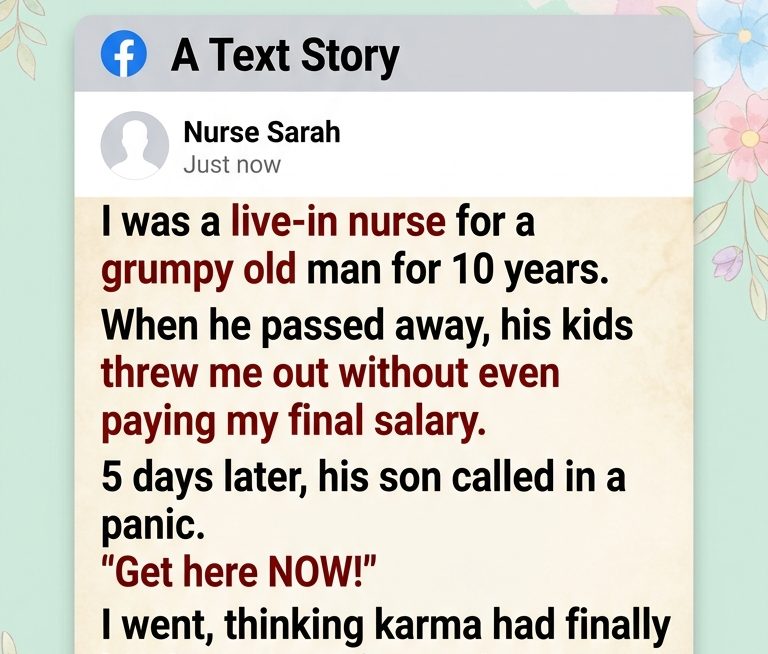
For ten years, I took care of Mr. Harold Bennett.
To everyone else, he was the grumpy old man at the end of Maple Street.
To me, he was simply Harold.
He was eighty-two when I first met him.
A retired engineer with bad knees, high blood pressure, and a reputation for driving away every caregiver his children hired.
“Good luck lasting a week,” his oldest son, Daniel, told me on my first day.
I almost proved him right.
Harold was stubborn.
He complained about everything.
The coffee was too hot.
The soup was too cold.
The television was too loud.
Then too quiet.
But beneath the gruff exterior was a lonely man whose children visited only on holidays.
Sometimes not even then.
Over the years, I learned his routines.
He liked jazz music on Sunday mornings.
He reread the same mystery novels every winter.
He secretly loved chocolate ice cream, even though his doctor told him to avoid sugar.
Slowly, his walls came down.
He started calling me “Kiddo.”
He trusted me with his medications, his fears, and the stories he’d never told anyone else.
When his health declined, I moved into the guest room to care for him full-time.
His children agreed.
They rarely visited, but they always had opinions.
“Don’t let Dad waste money on unnecessary things.”
“Make sure he signs these papers.”
“Tell him to consider selling the house.”
Harold usually rolled his eyes after they left.
“They’re waiting for me to die,” he once muttered.
I told him not to say things like that.
But deep down, I worried he might be right.
One rainy Tuesday morning, Harold passed away peacefully in his sleep.
I held his hand until the end.
I cried harder than I expected.
Ten years is a long time.
Long enough to become family.
At least, that’s what I thought.
His children arrived within hours.
By evening, their kindness disappeared.
Daniel pulled me aside.
“We won’t be needing you anymore.”
I nodded through tears.
“I understand.”
Then he added, “Please pack your things tonight.”
I stared at him.
“I’ve worked here for a decade.”
He shrugged.
“The house belongs to us now.”
When I asked about my final paycheck, his sister crossed her arms.
“We’ll mail it.”
They never did.
I left with two suitcases, my nursing bag, and a broken heart.
Not one of them thanked me.
Not one.
Five days later, my phone rang.
Daniel.
His voice shook with panic.
“Sarah, you need to come back. Right now.”
I almost hung up.
Instead, curiosity got the better of me.
Twenty minutes later, I pulled into the driveway.
The entire family stood on the porch.
Pale.
Anxious.
Scared.
Daniel rushed toward me.
“We found something under Dad’s bed.”
I followed him upstairs.
The bedroom looked exactly as I’d left it.
Except the bed had been moved.
Beneath it was a small wooden box.
I recognized it instantly.
I’d seen Harold slide it underneath years ago.
Once.
Only once.
When I asked about it, he’d smiled and said, “That’s for later.”
I never mentioned it again.
Daniel held out the key.
“It has your name on it.”
My heart skipped.
My name?
The family watched silently as I unlocked the box.
Inside were photo albums, letters, and a sealed envelope labeled:
For Sarah.
My hands trembled as I opened it.
Inside was a handwritten letter.
Dear Kiddo,
If you’re reading this, it means I’m gone.
First, thank you.
For every meal, every late-night emergency, every doctor appointment, and every time you sat with me when the pain was too much.
You gave me dignity when I felt I had none left.
You treated me like a human being, not a burden.
My children loved the idea of me, but you loved the reality.
There’s a difference.
Tears blurred the words.
The room was completely silent.
I kept reading.
I know they’ll probably forget to pay your final salary.
That’s why I made other arrangements.
Inside this box are copies of my updated will.
I leave my house equally to my children.
But I leave my lake cabin and investment account to you.
You’ve earned every penny.
Gasps filled the room.
Daniel’s sister stepped forward.
“What?”
I ignored her.
There was more.
And one last thing.
Underneath the false bottom of this box is something I’ve kept for years.
Please share it with my children.
I carefully lifted the velvet lining.
Beneath it sat dozens of unopened birthday cards.
Christmas cards.
Father’s Day cards.
Every one addressed to Harold.
Every one returned unopened.
The dates spanned nearly fifteen years.
Harold hadn’t ignored his children.
His children had stopped trying long before they claimed he pushed them away.
Daniel’s face turned white.
His sister covered her mouth.
Then I noticed another envelope.
Written in Harold’s shaky handwriting:
To my children.
Daniel opened it.
His eyes filled with tears as he read aloud.
You always told people I was difficult.
Maybe I was.
But relationships require effort from both sides.
Sarah stayed when it was hard.
You left when it became inconvenient.
This isn’t punishment.
It’s simply recognition.
Love is shown through time.
And she gave me hers.
Nobody spoke.
For the first time in ten years, I saw genuine regret on their faces.
Not because of the inheritance.
Because they realized what they’d lost.
Time they could never get back.
Conversations they’d never have.
Apologies they’d never make.
A week later, my final paycheck arrived with an apology note.
I deposited the check.
But the money didn’t matter.
Neither did the cabin or the investment account.
What mattered was knowing Harold saw me.
He appreciated me.
He understood that caring for someone isn’t just a job.
It’s an act of love.
Today, I still visit the lake cabin every summer.
I sit on the porch with a cup of coffee and listen to jazz music on Sunday mornings.
Just like Harold used to.
And sometimes, when the wind rustles through the trees, I can almost hear his voice.
“Thanks, Kiddo.”
No, Harold.
Thank you.